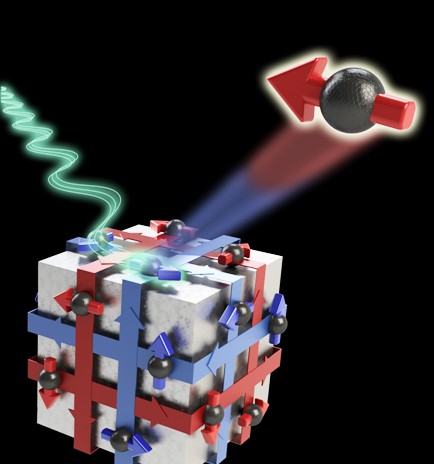
The interior bulk of a topological insulator is indeed an insulator, but electrons (spheres) move swiftly on the surface as if through a metal. They are spin-polarized, however, with their momenta (directional ribbons) and spins (arrows) locked together. Berkeley Lab researchers have discovered that the spin polarization of photoelectrons (arrowed sphere at upper right) emitted when the material is struck with high-energy photons (blue-green waves from left) is completely determined by the polarization of this incident light. (Image Chris Jozwiak)
Plain-looking but inherently strange crystalline materials called 3D topological insulators (TIs) are all the rage in materials science. Even at room temperature, a single chunk of TI is a good insulator in the bulk, yet behaves like a metal on its surface. Researchers find TIs exciting partly because the electrons that flow swiftly across their surfaces are "spin polarized": the electron's spin is locked to its momentum, perpendicular to the direction of travel. These interesting electronic states promise many uses - some exotic, like observing never-before-seen fundamental particles, but many practical, including building more versatile and efficient high-tech gadgets, or, further into the future, platforms for quantum computing. A team of researchers from the U.S. Department of Energy's Lawrence Berkeley National Laboratory (Berkeley Lab) and the University of California at Berkeley has just widened the vista of possibilities with an unexpected discovery about TIs: when hit with a laser beam, the spin polarization of the electrons they emit (in a process called photoemission) can be completely controlled in three dimensions, simply by tuning the polarization of the incident light. "The first time I saw this it was a shock; it was such a large effect and was counter to what most researchers had assumed about photoemission from topological insulators, or any other material," says Chris Jozwiak of Berkeley Lab's Advanced Light Source (ALS), who worked on the experiment.
TO READ THIS ARTICLE, CREATE YOUR ACCOUNT
And extend your reading, free of charge and with no commitment.