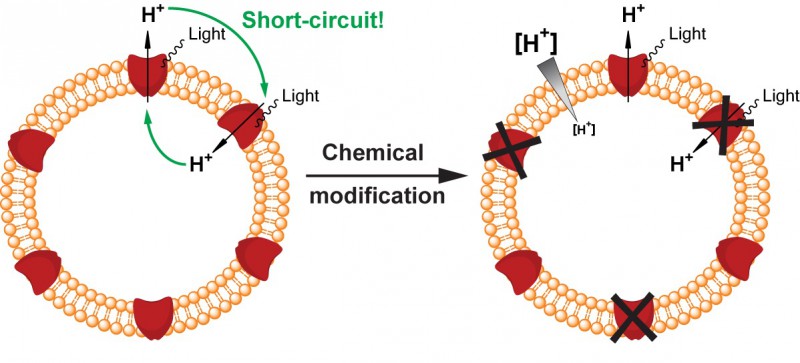
 Nanocontainer consisting of lipid (in orange) and the engineered version of proteorhodopsin (in red). Light irradiation of the molecular system fails in establishing a proton gradient across the membrane because of the symmetrical integration of proteorhodopsins, which results in a short-circuit (left). After chemically switching off wrongly oriented proteorhodopsins (right), correctly oriented ones can establish a proton gradient across the membrane (indicated in gray).
Synthetic biology is an emerging and rapidly evolving engineering discipline. Within the NCCR Molecular Systems Engineering, Bernese scientists have engineered a chemically switchable version of the light-driven proton pump proteorhodopsin - an essential tool for efficiently powering molecular factories and synthetic cells. Synthetic biology is a highly interdisciplinary field, which combines biology, chemistry and physics with engineering. Its goal is to design molecular factories and synthetic cells with novel properties or functions for applications in healthcare, industry, or biological and medical research. Such artificial systems are in the nanometer scale and are built by combining and assembling existing, synthetic or engineered building blocks (e.g., proteins). Molecular systems have wide application ranges, e.g., for chemical compound synthesis, waste disposal, energy supply and medical diagnosis or treatment. In this context, the NCCR Molecular Systems Engineering brings Swiss scientists from different disciplines together to stimulate innovation, and address existing and future challenges.
TO READ THIS ARTICLE, CREATE YOUR ACCOUNT
And extend your reading, free of charge and with no commitment.
Your Benefits
- Access to all content
- Receive newsmails for news and jobs
- Post ads