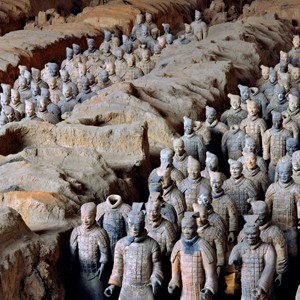
The Terracotta Army, by Xia Juxian
The most comprehensive analysis of the Terracotta Army's weapons has revealed that the craftsmen responsible for arming the 7000 warriors, chariots and horses followed a sophisticated labour model now associated with Toyota, the world's biggest car maker. Toyota is widely credited with introducing an alternative method of mass production to standard assembly lines. Sometimes referred to as 'Toyotism', the approach involves using small workshops of highly skilled engineers, capable of producing any model of car as and when it is needed, rather than a production line where each unit concentrates on making individual components. Now new research by a team from UCL's Institute of Archaeology and the Museum of Emperor Qin Shihuang's Mausoleum in Xian has shown that, rather than being a novel innovation, 'Toyotism' may have been developed by craftsmen working on China's Terracotta Army more than 2000 years before the Japanese carmaker was founded. The paper "Forty Thousand Arms for a Single Emperor", published in the current edition of the Journal of Archaeological Method and Theory, demonstrates the extraordinary level of skill and versatility of the craftsmen who created the Army and their thousands of bronze weapons. The paper is the latest publication from the "Imperial Logistics" project, the largest international project to investigate the Terracotta Army. Lead author Marcos Martinón-Torres (UCL Institute of Archaeology) said that they had inspected more than 1,600 arrow heads and, finding them identical to the naked eye, assumed they had come from a single, large-scale production line.
TO READ THIS ARTICLE, CREATE YOUR ACCOUNT
And extend your reading, free of charge and with no commitment.