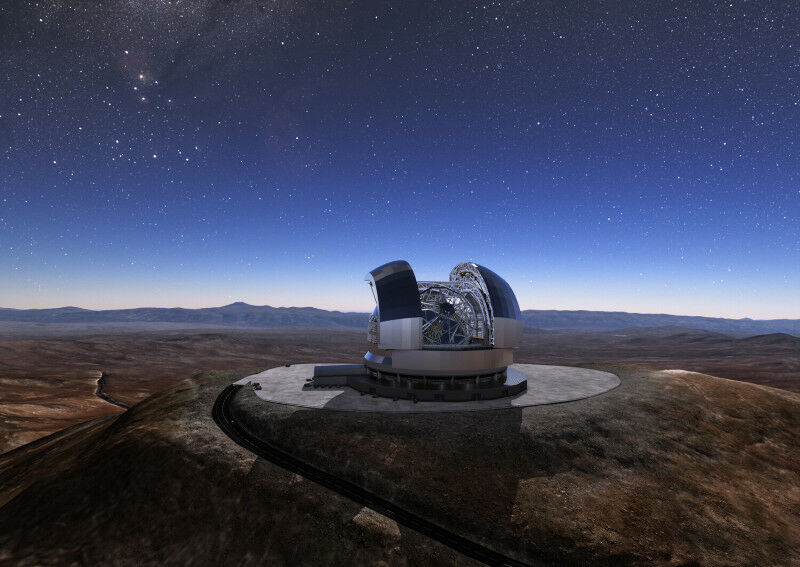
The European Extremely Large Telescope (ELT) is being built on Cerro Armazones in the Chilean desert near the ESO’s Paranal Observatory. With its mirror diameter of 39 meters, it will be the world’s largest eye in the sky. Here, an artist’s rendering shows what the telescope will look like once it is completed on the mountain. Photo: ESO/L. Calçada
University of Göttingen involved in the development of a new high-resolution spectrograph
The European Southern Observatory (ESO) has signed an agreement with an international consortium of institutions to develop and build ANDES, the ArmazoNes High Dispersion Echelle Spectrograph. The ANDES instrument will be installed on ESO’s Extremely Large Telescope (ELT). The scientific objectives are to search for signs of life on exoplanets, identify the first stars, test variations in the fundamental constants of physics and measure the acceleration of the expansion of the universe. The Institute of Astrophysics and Geophysics at the University of Göttingen is also involved in this project.
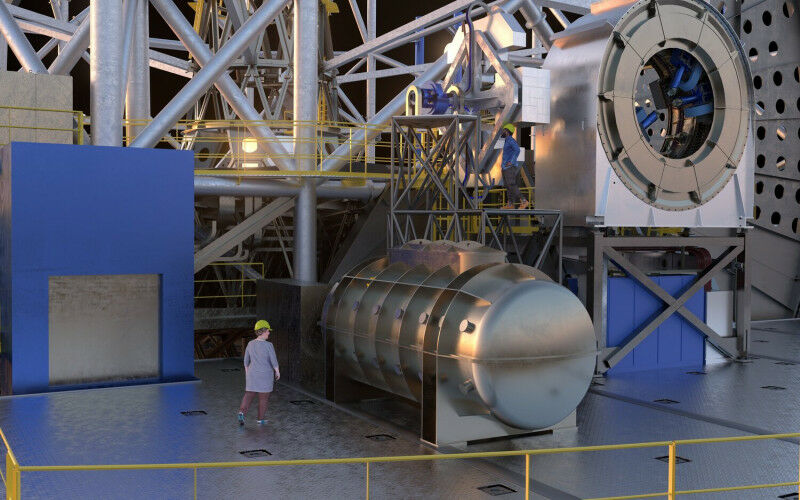
The high-resolution spectrograph ANDES in this artist’s impression will be one of the instruments for the Extremely Large Telescope (ELT) in Chile. Photo: ESO ANDES is a powerful spectrograph, an instrument that splits light into its individual wavelengths so that scientists can determine important properties of astronomical objects, such as their chemical composition. The instrument will have unprecedented wavelength precision in the visible and near-infrared range of light and, in combination with the ELT’s powerful mirror system, will pave the way for research in numerous areas of astronomy.
ANDES will carry out detailed studies of the atmospheres of Earth-like exoplanets and enable researchers to search for signs of life forms. It will analyze chemical elements in distant objects from the early universe and is expected to be the first instrument capable of detecting Population III stars, the earliest stars in the universe. Scientists will also be able to use the ANDES data to test whether fundamental physical constants change with time and space. The extensive measurement data will also record the acceleration and expansion of the universe, one of the greatest mysteries of our cosmos.
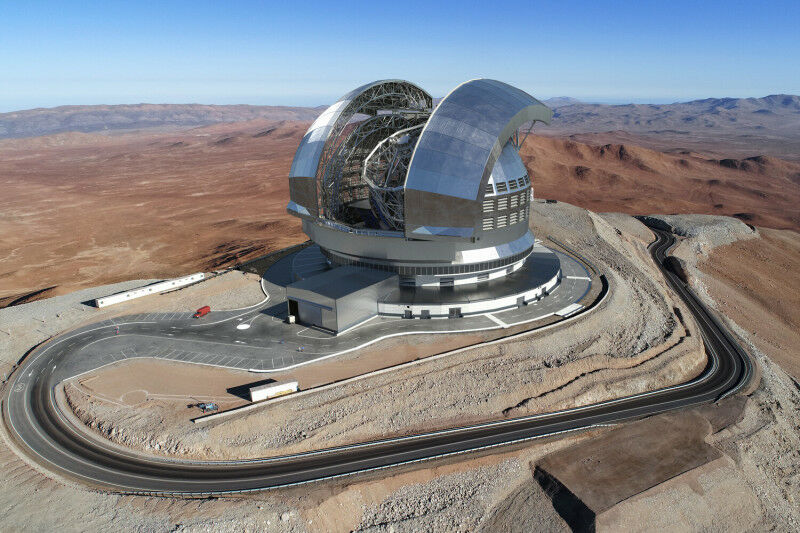
The Extremely Large Telescope (ELT) will be located on the summit of Cerro Armazones, some 3046 meters high in the Chilean Atacama Desert, surrounded by breathtaking views of the plains below. Once erected, the telescope will point into the night sky and give us a deep look into our universe. The leveling of the summit of Cerro Armazones in preparation for the construction of the ELT was completed in 2015. Photo: ESO The Institute of Astrophysics and Geophysics at the University of Göttingen is responsible for calibrating the new instrument. ESO’s ELT, which is currently being built in the Atacama Desert in northern Chile, will have a primary mirror with a diameter of 39 meters consisting of 798 hexagonal segments. The ELT is scheduled to go into operation by 2030. It will be the largest optical telescope in the world and will usher in a new era of ground-based astronomy.