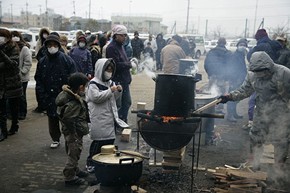
Above: Children line up for food and water at an evacuation center in Sendai. Photo: Jensen Walker/Getty Images for Save the Children
Japan can emerge from this disaster strengthened and more vigorous, writes Tessa Morris-Suzuki. The word 'crisis' is one of the most overused terms in the media lexicon. Just over a week ago, the government of Japanese Prime Minister Naoto Kan was said to be facing its 'greatest crisis' to date. The cause of this political furore was a string of resignations by ruling party politicians, most notably the foreign minister, who had been forced to step down after admitting to a minor breach of Japan's campaign funding laws. This week, months of bitter political feuding melted into utter irrelevance. 'Crisis' suddenly took on a raw and shocking new meaning as the same government found itself struggling to deal with a cataclysm whose death toll is soaring into the tens of thousands and with the worst nuclear disaster since Chernobyl. Just as 11 September 2001, with its images of New York's collapsing twin towers, has been seared into global memory, so 11 March 2011 will forever be associated with those seemingly impossible pictures of ships marooned on the roofs of houses, whole towns engulfed in a matter of minutes by the forces of nature, and explosions of smoke and steam billowing from nuclear power plants that were supposed to be disaster-proof. Japan will, of course, survive this double catastrophe. Overwhelming though the task may seem, Japanese society will recover. But will it ever be the same again? How will the Japan of the future differ from country pre-3/11? Read the full article at Inside Story.
TO READ THIS ARTICLE, CREATE YOUR ACCOUNT
And extend your reading, free of charge and with no commitment.