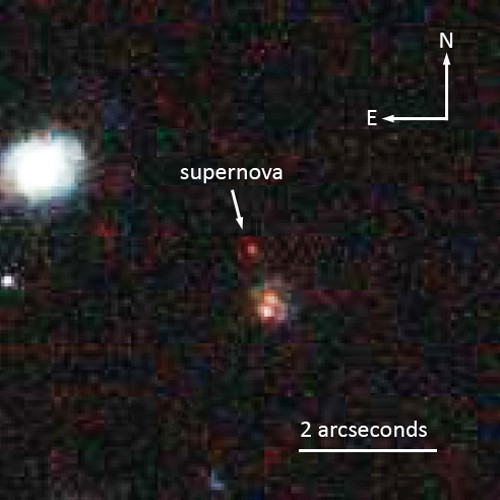
Supernova SCP-0401, nicknamed "Mingus," was collected by the Hubble Space Telescope in 2004 but could not be positively identified until after the installation of a new camera that serendipitously acquired more data. (Photo Space Telescope Science Institute)
What if you had a "Wayback Television Set" and could watch an entire month of ancient prehistory unfold before your eyes in real time? David Rubin of the U.S. Department of Energy's Lawrence Berkeley National Laboratory (Berkeley Lab) presented just such a scenario to the American Astronomical Society (AAS) meeting in Long Beach, CA, when he announced the discovery of a striking astronomical object: a Type Ia supernova with a redshift of 1.71 that dates back 10 billion years in time. Labeled SN SCP-0401, the supernova is exceptional for its detailed spectrum and precision color measurement, unprecedented in a supernova so distant. "This is the most distant supernova anyone has ever found for doing dependable cosmology," says Rubin, a member of the international Supernova Cosmology Project (SCP) based at Berkeley Lab. "The most important unanswered question we have about the nature of dark energy is whether it varies over time - whether it affects the expansion of the universe differently in different eras.
TO READ THIS ARTICLE, CREATE YOUR ACCOUNT
And extend your reading, free of charge and with no commitment.