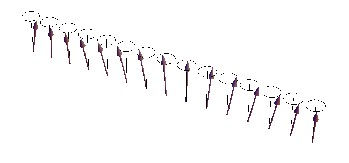
Earlier theories by Nobel Laureate Yoichiro Nambu predicted that magnetic spins oscillate in two directions independently, and thus magnets have two Nambu-Goldstone bosons. The new theory shows that in ferromagnets, these two waves are not independent, so that the there is only one Nambu-Goldstone boson, a precession wave as shown above. Credit: Haruki Watanabe/UC Berkeley.
Collective vibrations in a crystal, called phonons, are a type of Nambu-Goldstone boson. UC Berkeley physicists have proved that counting the number of bosons in a material, whether a solid crystal, a magnet, or a superfluid, tells you what type of behavior the material will have at low temperatures where symmetry is spontaneously broken. Credit: Haruki Watanabe/UC Berkeley. Matter exhibits weird properties at very cold temperatures. Take superfluids, for example: discovered in 1937, they can flow without resistance forever, spookily climbing the walls of a container and dripping onto the floor. In the past 100 years, 11 Nobel Prizes have been awarded to nearly two dozen people for the discovery or theoretical explanation of such cold materials - superconductors and Bose-Einstein condensates, to name two - yet a unifying theory of these extreme behaviors has eluded theorists. University of California, Berkeley, physicist Hitoshi Murayama and graduate student Haruki Watanabe have now discovered a commonality among these materials that can be used to predict or even design new materials that will exhibit such unusual behavior.
TO READ THIS ARTICLE, CREATE YOUR ACCOUNT
And extend your reading, free of charge and with no commitment.