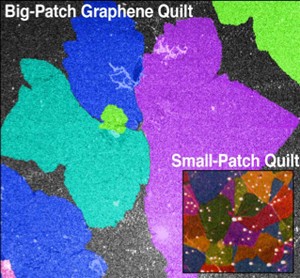
False-color microscopy images show examples of graphene grown slowly, resulting in large patches with poor stitching, and graphene grown more quickly, resulting in smaller patches with tighter stitching and better performance.
Similar to how tighter stiches make for a better quality quilt, the "stitching" between individual crystals of graphene affects how well these carbon monolayers conduct electricity and retain their strength, Cornell researchers report. The quality of this "stitching" - the boundaries at which graphene crystals grow together and form sheets - is just as important as the size of the crystals themselves, which scientists had previously thought held the key to making better graphene. The researchers, led by Jiwoong Park, assistant professor of chemistry and chemical biology and a member of the Kavli Institute at Cornell for Nanoscale Science, used advanced measurement and imaging techniques to make these claims, detailed online June 1. Graphene is a single layer of carbon atoms, and materials scientists are engaged in a sort of arms race to manipulate and enhance its amazing properties - tensile strength, high electrical conductance, and potential applications in photonics, photovoltaics and electronics. Cartoons depict graphene like a perfect atomic chicken wire stretching ad infinitum. In reality, graphene is polycrystalline; it is grown via a process called chemical vapor deposition, in which small crystals, or grains, at random orientations grow by themselves and eventually join together in carbon-carbon bonds. In earlier work published in Nature last January, the Cornell group had used electron microscopy to liken these graphene sheets to patchwork quilts - each "patch" represented by the orientation of the graphene grains (and false colored to make them pretty).
TO READ THIS ARTICLE, CREATE YOUR ACCOUNT
And extend your reading, free of charge and with no commitment.