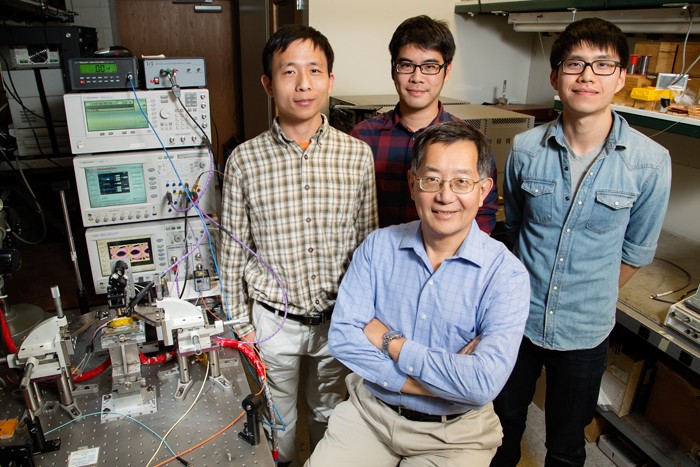
University of Illinois engineers - from left, postdoctoral researcher Fei Tan, graduate students Mong-Kai Wu and Michael Liu, led by Milton Feng, front - developed a laser that can transmit data at a blazing fast 40 gigabits per second, without errors - the fastest in the U.S.
CHAMPAIGN, Ill. High-speed communication just got a turbo boost, thanks to a new laser technology developed at the University of Illinois that transmits error-free data over fiber optic networks at a blazing fast 40 gigabits per second - the fastest in the United States. Milton Feng , the Nick Holonyak Jr. Chair in Electrical and Computer Engineering , demonstrated the tiny, fast device along with postdoctoral researcher Fei Tan, graduate students Mong-Kai Wu and Michael Liu, and Holonyak, who is an emeritus professor. The team published its results in the journal IEEE Photonics Technology Letters. As computation shifts into the petascale and beyond, processor speeds have outstripped transfer speeds, creating a bottleneck and hindering applications. Anyone who has tried to stream video over a dial-up Internet connection knows that the fastest processor won't help the file load quicker. And in the age of "big data" and cloud computing, there's a lot of information swirling among servers. Laser devices called oxide VCSELs are used to transmit data over fiber optic cables at high speed. They can carry data faster and in greater quantities than traditional electrical cables. "The oxide VCSEL is the standard right now for industry," Feng said. "Today, all the optical interconnects use this technology. The world is in a competition on how to make it fast and efficient, and that's what this technology is. At the U. of I., we were able to make this technology the fastest in the U.S." How fast is it?
TO READ THIS ARTICLE, CREATE YOUR ACCOUNT
And extend your reading, free of charge and with no commitment.