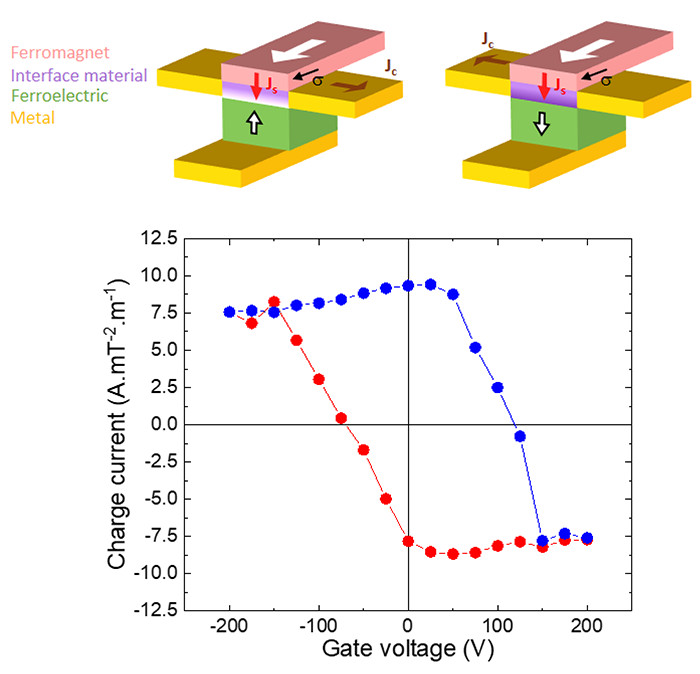
 (Top) Example of the system developed: a ferromagnetic material that can generate a spin current and inject it into an interface material, in which it is converted into a charge current. Traditionally, in order to change the sign of the charge current produced, the magnetization of the ferromagnetic material must be reversed by applying a magnetic field or a powerful current. Here this is produced by reversing the polarisation of the ferroelectric material using an electric field. (Bottom) Experimental curve showing the evolution of the charge produced as a function of the voltage applied to the ferroelectric material.
( Top ) Example of the system developed: a ferromagnetic material that can generate a spin current and inject it into an interface material, in which it is converted into a charge current. Traditionally, in order to change the sign of the charge current produced, the magnetization of the ferromagnetic material must be reversed by applying a magnetic field or a powerful current. Here this is produced by reversing the polarisation of the ferroelectric material using an electric field. Bottom ) Experimental curve showing the evolution of the charge produced as a function of the voltage applied to the ferroelectric material. CNRS/Thales and Spintec (CNRS/CEA/Université Grenoble Alpes). Electron spin-a fundamentally quantum property-is central to spintronics, a technology that revolutionized data storage, 1 and that could play a major role in creating new computer processors. In order to generate and detect spin currents, spintronics traditionally uses ferromagnetic materials whose magnetization switching consume high amounts of energy.
TO READ THIS ARTICLE, CREATE YOUR ACCOUNT
And extend your reading, free of charge and with no commitment.
Your Benefits
- Access to all content
- Receive newsmails for news and jobs
- Post ads