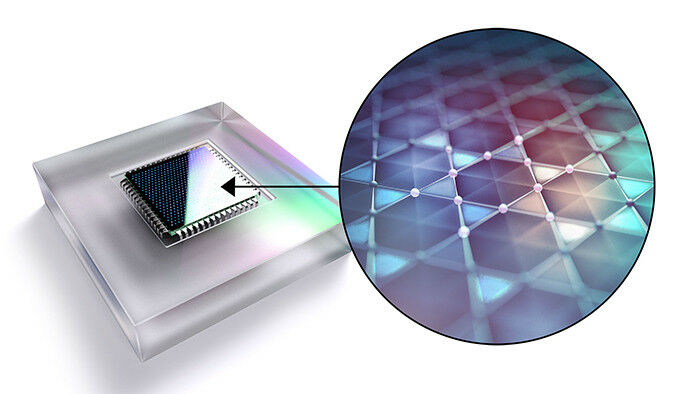
Quantum chip with basketweave pattern: A research team from the Würzburg-Dresden Cluster of Excellence ct.qmat has engineered an algorithm capable of determining the ground state of a 12-atom kagome lattice. For this code, the researchers won second place in the international IBM Quantum Open Science competition. The new algorithm can be used by IBM to train its quantum chips. (Image: Jörg Bandmann / Exzellenzcluster ct.qmat)
Quantum chip with basketweave pattern: A research team from the Würzburg-Dresden Cluster of Excellence ct.qmat has engineered an algorithm capable of determining the ground state of a 12-atom kagome lattice. For this code, the researchers won second place in the international IBM Quantum Open Science competition. The new algorithm can be used by IBM to train its quantum chips. (Image: Jörg Bandmann / Exzellenzcluster ct.qmat) A team of five, headed by quantum physicist Professor Ronny Thomale of the Würzburg-Dresden Cluster of Excellence ct.qmat, secured second place in the international IBM Quantum Open Science Prize. The global race to master quantum computing is heating up. Both the tech industry and a huge scientific community are navigating multiple avenues with one common objective: the creation of an extremely powerful and universally functional quantum computer. Quantum computing holds the potential to propel advances in areas like artificial intelligence and machine learning.
TO READ THIS ARTICLE, CREATE YOUR ACCOUNT
And extend your reading, free of charge and with no commitment.