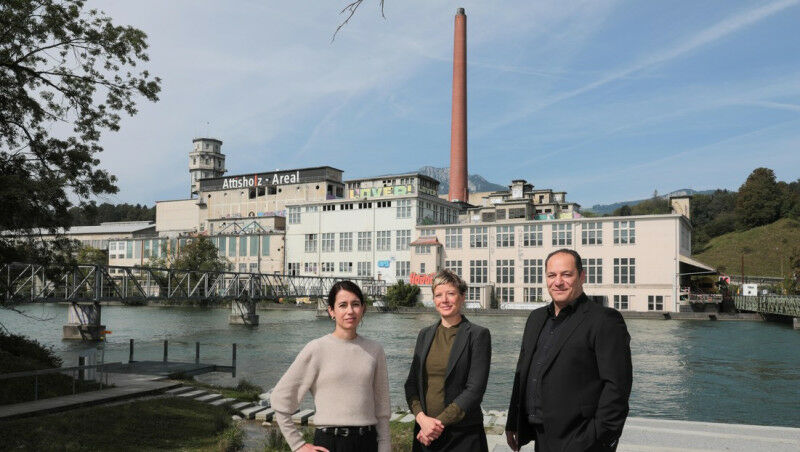
 The authors at Luterbach-Attisholz (SO), a Swiss site presented in their book.
The authors at Luterbach-Attisholz (SO), a Swiss site presented in their book. A. Herzog/EPFL - Urban brownfields represent a major challenge to sustainable transition that remains difficult to overcome. A new reference work, based on over ten years of research carried out at EPFL, aims to outline the processes involved in transforming urban brownfields into sustainable neighborhoods. Urban brownfields are derelict areas that are diverse in origin; they include military barracks and parade grounds, ports, decommissioned nuclear power plants and refineries, and railway, industrial and commercial wastelands. They present specific challenges when it comes to transforming them into sustainable neighborhoods. Assuming a medium scenario of population density, Switzerland's urban brownfields could theoretically accommodate around 600,000 new residents. However, regenerating these areas according to 21
st century sustainability standards can pose real problems - many issues need to be addressed, such as soil pollution, impermeable surfaces, inadequate accessibility, costly demolitions, unattractive neighborhoods, derelict infrastructure, multiple stakeholders and divergent opinions.
TO READ THIS ARTICLE, CREATE YOUR ACCOUNT
And extend your reading, free of charge and with no commitment.
Your Benefits
- Access to all content
- Receive newsmails for news and jobs
- Post ads