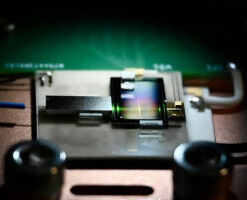
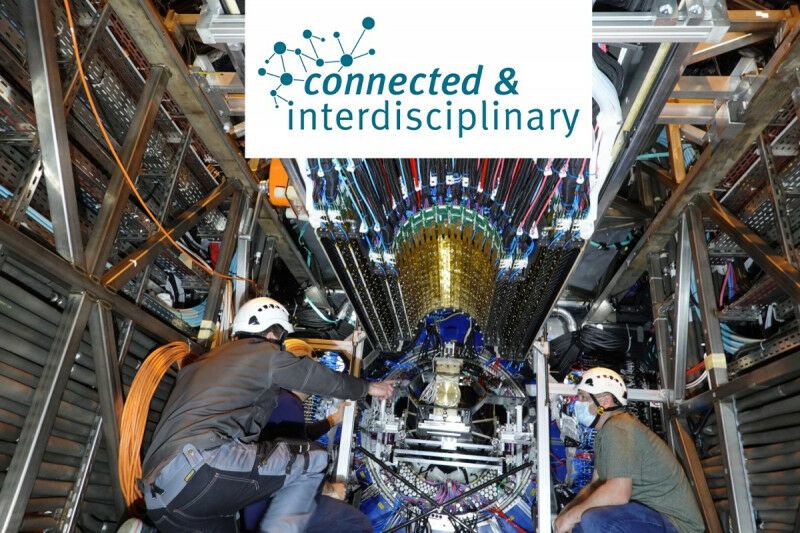
 Installing the new ALICE silicon detector near the LHC beam tube
Physicist Christian Klein-Bösing about the collaboration at CERN, one of the world's largest research centres. Installing the new ALICE silicon detector near the LHC beam tube © privat Uncovering the secrets of the universe: this is one of many aims which CERN (European Organisation for Nuclear Research) in Geneva has. With its 23 member states and around 3,400 people working there, CERN is the world's largest research centre in the field of particle physics. More than 14,000 visiting researchers from 85 countries are at work on CERN experiments. One of them is Prof. Christian Klein-Bösing from the Institute of Nuclear Physics at the University of Münster. One of the things he is working on is the ALICE project (A Large Ion Collider Experiment) - one of the four major experiments being undertaken at CERN's Large Hadron Collider (LHC) and, with its 27 kilometres, the largest particle accelerator in the world. In this interview with Kathrin Kottke , nuclear and particle physics expert Christian Klein-Bösing explains what precisely the project is about and what collaboration is like in a large international team.
TO READ THIS ARTICLE, CREATE YOUR ACCOUNT
And extend your reading, free of charge and with no commitment.
Your Benefits
- Access to all content
- Receive newsmails for news and jobs
- Post ads