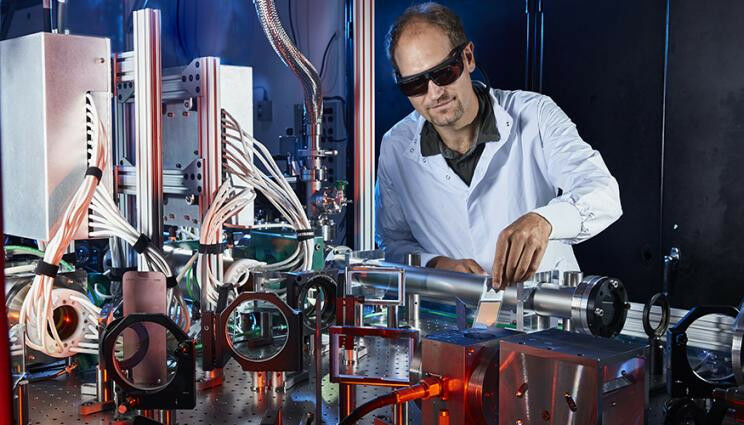
Andrew Longman aligns the COMET laser at Lawrence Livermore National Laboratory’s Jupiter Laser Facility. Upcoming experiments using the COMET laser in early 2023 aim to create some of the strongest static magnetic fields ever generated by a laser.
Andrew Longman aligns the COMET laser at Lawrence Livermore National Laboratory's Jupiter Laser Facility. Upcoming experiments using the COMET laser in early 2023 aim to create some of the strongest static magnetic fields ever generated by a laser. Electromagnetic vortices occur naturally throughout the universe and have recently been observed in association with black holes. Over the last decade, scientists have sought methods to investigate how extremely strong electromagnetic vortices interact with matter, specifically plasma, in a laboratory setting. Plasma, known as the "fourth state of matter," makes up nearly all observable matter in the universe and consists of freely moving ions and free electrons. The use of high-intensity lasers to generate electromagnetic vortices have shown great promise and have the potential to unlock new physics when such beams interact with plasma. Andrew Longman, a High Energy Density Science (HEDS) Center postdoctoral fellow for Lawrence Livermore National Laboratory (LLNL), proposes that spiral phase mirrors, when incorporated into a laser system, will enable scientists to "twist" the laser light and generate an optical vortex.
TO READ THIS ARTICLE, CREATE YOUR ACCOUNT
And extend your reading, free of charge and with no commitment.