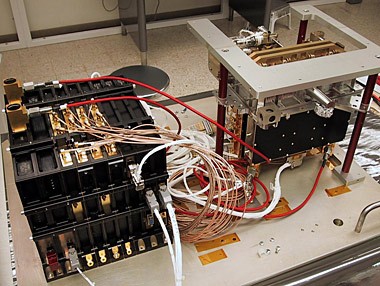
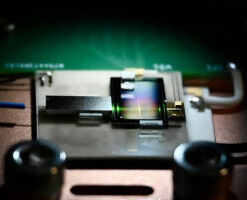
The far ultraviolet detector, built by Space Sciences Laboratory physicists, is part of the Cosmic Origins Spectrograph to be installed on the aging Hubble Space Telescope.
BERKELEY — NASA's final mission to the 17-year-old Hubble Space Telescope, which begins May 11, will deliver a new instrument partly built by University of California, Berkeley, physicists to map the structure of the universe. The far ultraviolet detector, built by Space Sciences Laboratory physicists, is part of the Cosmic Origins Spectrograph to be installed on the aging Hubble Space Telescope. (Space Sciences Laboratory photo) The Cosmic Origins Spectrograph (COS) contains both a far ultraviolet detector built at UC Berkeley's Space Sciences Laboratory and a near ultraviolet detector provided by Ball Aerospace & Technologies Corp. of Boulder, Colo. The spectrograph package was designed, assembled and readied for the Hubble Space Telescope by scientists at the University of Colorado, Boulder, under the leadership of the principal investigator James Green, professor of astrophysical and planetary sciences and a former UC Berkeley graduate student. COS is designed to explore the "cosmic web," a rarefied network of hot and ionized gas lanes connecting galaxies and dating from the early universe, according to Barry Welsh, a UC Berkeley astronomer who will be working with the new data from COS. By studying this web of hot gas, astronomers hope to detail the evolution of the large-scale structure of the universe seen today as walls and sheets of galaxies surrounding huge voids.
TO READ THIS ARTICLE, CREATE YOUR ACCOUNT
And extend your reading, free of charge and with no commitment.