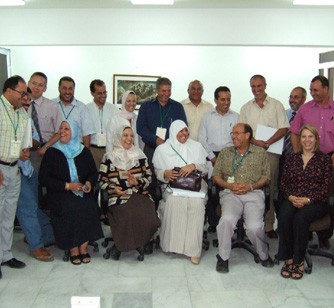
The first set of course participants in December 2006
There has been a lot of interest in the past week in UK universities? involvement in Libya. Although UCL has no institutionally signficant links with Libya, a group of academics from UCL's Division of Medical Education have been working on a humanitarian project in the country. In 2006 the teaching and professional development team at the UCL Division of Medical Education (DoME) were approached by one of their course participants, a Libyan who is involved in medical education in the UK. He felt there was an opportunity to use the skills of UCL medical educators to help improve the standard of undergraduate medical education with the potential to improve patient care in Libya. Jane Richardson, senior lecturer in medical education, explains: 'This project came about through a Libyan doctor working in London who came on our medical teachers' course and approached our department for help. He himself had been in exile for many years and, like many of his fellow doctors who have recently returned to live and work in Libya, believed that the time was ripe for reforms in medical education in Libya.' From these informal beginnings, a group of academics from the UCL Division of Medical Education and the Libyan Board of Medical Specialities, a professional group similar to the UK medical Royal Colleges, drew up a Memorandum of Understanding. Their aim was to provide high quality medical education courses.
TO READ THIS ARTICLE, CREATE YOUR ACCOUNT
And extend your reading, free of charge and with no commitment.