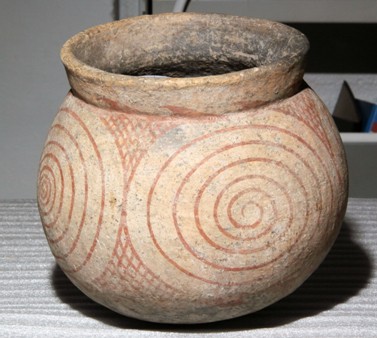
Vessel, globular
cord marked bowl with red on buff spiral design. Ban Chiang
culture, late
period 300 BC ? AD 200
Sixteen objects, thought to originate from the UNESCO World Heritage Site at Ban Chiang in Thailand, will be returned to the Thai Department of Fine Arts by the UCL Institute of Archaeology. The artefacts date from the Neolithic to Iron ages, between the 2200 BC to AD 200. They include a selection of vessels, bracelets and adzes that are thought to have come from either Ban Chiang or nearby sites in the Sakorn Nakhon basin, just south of the Mekong. They were donated to the Institute in the mid-1970s and were used in the teaching of South East Asian prehistory at UCL until the 1980s. Since then, the items have been held in storage at the UCL Institute of Archaeology and were rediscovered in August 2009 as part of an ongoing audit of UCL's cultural property collections. An event held this evening at the Royal Thai Embassy in London will mark the official transfer of the artefacts. Memorandums of understanding will be signed by the Embassy and the Institute to commemorate the transfer and promote Thai Studies at UCL through the establishment of a scholarship.'In accordance with our commitment to UNESCO's Convention on the Means of Prohibiting and Preventing the Illicit Import, Export and Transfer of Ownership of Cultural Property we are in the process of re-cataloguing all cultural property acquired by the Institute of Archaeology since 1970,? says Professor Stephen Shennan, Director of the UCL Institute of Archaeology.
TO READ THIS ARTICLE, CREATE YOUR ACCOUNT
And extend your reading, free of charge and with no commitment.