News from
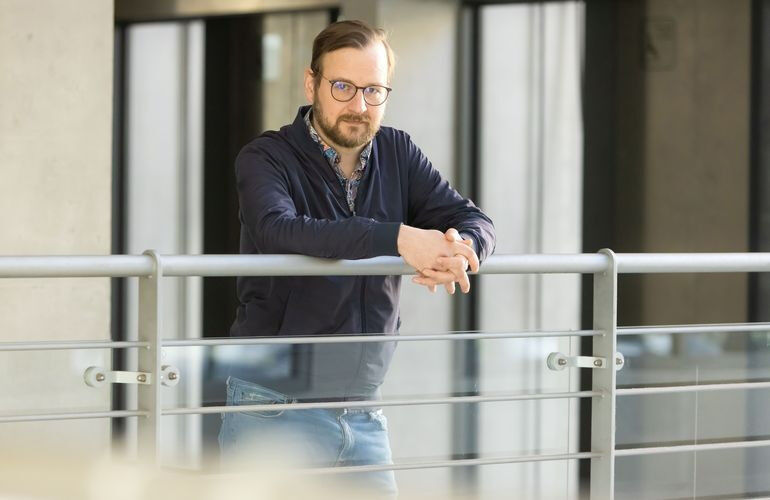
Last year, Dr. Alexander Leistner, a sociologist at the University of Leipzig, launched the unusual project "Überlandschreiberinnen - Ways across the Country". Now the "project book" has been published, written by Leistner and the writers Manja Präkels, Tina Pruschmann and Barbara Thériault. It is entitled "Extreme weather situations - reportages from a new Germany" and contains a variety of civil society voices and observations in rural regions. In an interview, project manager Leistner talks about the idea, the approach and important findings. The book indicates "how serious the situation is".
Dr. Leistner, the idea of transfer has always played a major role for you. How did this come about?
The idea came about more than two years ago and from a feeling of scientifically informed anxiety. With the state elections in Brandenburg, Saxony and Thuringia in mind, I had several questions on my mind: How can science even keep pace with the rapid erosion processes, especially at the local level, in small-town rural regions? Do we not need to take another look at the atmospheric nature of political upheaval? And don’t we need a different language in the circular debates in and about East Germany? And then there was the idea, analogous to the concept of the city scribe, of assigning an "overland scribe" to each federal state in which elections would be held, who would accompany the elections for months. But to be honest, I never thought I would find a sponsor for such a project and it was an absolute stroke of luck that the Volkswagen Foundation set up a funding program at the same time that is really serious about rewarding risky project ideas.
The subtitle of the book published by "Verbrecher Verlag" is "Reportages from a new Germany" - to what extent is it a product of science or science communication?
The title was deliberately chosen as a reference to a long line of tradition within sociology. At the beginning of the 20th century, sociologists such as Georg Simmel and Siegfried Kracauer wrote their own reportages and feuilletons in newspapers, thus establishing an almost forgotten sociological genre in which (everyday) observations are combined with their almost casual analysis and written in an entertaining, profound, clear and precise, almost literary way. The idea was that sociology and literature should meet in the project and in the book with the aim of contributing to a deeper understanding of the political upheavals.
Who should the book reach, what do you hope to achieve?
At one point in the book it says "the art of remaining many". And so I would say it is a book for the many. Those who are committed to democracy in East Germany, who are concerned about developments, who are interested in East Germany beyond short-winded election reporting. But also for anyone who wants to discover how our society is developing through everyday observations. And where. And in this last sense, it is also a book for political leaders: It hints at how serious the situation is.
The project description states: "With Manja Präkels, Tina Pruschmann and Barbara Thériault, three renowned authors were sent out as ’Überlandschreiberinnen’ to explore the mood in East Germany, to make hidden social rifts and tipping points visible. While Manja Präkels specifically visited civil society initiatives and hotspots in Brandenburg, Tina Pruschmann traveled to remote regions in Saxony’s Ore Mountains by bike. Barbara Thériault joined a Thuringian newspaper as a local journalist, and Alexander Leistner followed mental lines of development, some of whose beginnings can be traced back to before 1989. This resulted in literary reportages about the normalization of right-wing extremist structures and narratives, threatened cultural associations and memorials, bizarre infrastructure projects in ruined landscapes."
How should we imagine the process? Did you provide the writers with scientific methods?

No, but we discussed and agreed intensively: about the places, about observing quite openly. We wanted them to bring their strengths to bear and, in our experience, scientific knowledge emerged differently: from the power and language of literary description, which is often much more analytically dense than scientific texts could achieve. Knowledge arose from the principle of assembling individual observations into a larger picture or from ambivalence when our observations contradicted each other at first glance. What does it mean when we observe both the claim to power over public space and the street by right-wing extremists and at the same time the emptiness of the streets in everyday life?
Has the format proved successful? What would you do the same again, what would you do differently?
The one-year project funding was a challenge for such a demanding cooperation because we had to find each other very quickly and sometimes there wasn’t enough time to talk much more intensively about the wealth of observations. And this was also intensified by the insane dynamics of the political situation - if you think of the USA, East Germany is just one part of a worldwide development. And even if a huge strength of our writing is the slowing down - a few more pauses would certainly have done us good. There is also a short text in the book about our tiredness.
What do you think are the key insights in terms of content?
One insight is in the subtitle - that we are living in a "new Germany". It is the observation that the erosion processes of democracy are already so far advanced that one can ask with certain topics or in certain regions whether we are still living before these upheavals, in the midst of them, or already in a diffuse aftermath. But the book thrives on the multitude of observations and the questions that this raises. For example: What happens when nothing happens - in other words, how does a local climate change when talk of politics is totally absent? Or the observation that there is a society of train and car drivers. Where do these social circles meet and what does it mean to belong or not belong?
What projects will you tackle next? And what form of science communication would you be most interested in?
We have just submitted an application to the Volkswagen Foundation, and that alone would open up completely new possibilities, because a very exciting phase is now beginning. We will soon be on a reading tour with the book in large and hopefully many small-town/rural locations. And the next texts and research questions are already emerging from being on the road, feedback and audience reactions.
Project manager Dr. Alexander Leistner was also responsible for two sub-projects of the BMBF research network "The Controversial Legacy of 1989" at the Institute of Cultural Studies at Leipzig University. The idea of transfer always plays an important role in his research on upheavals in the political culture of East Germany and the associated threats to a democratically constituted community. For example, Leistner and his team have developed the format of practical workshops for the Erbe ’89 research network, which for many years has facilitated a twice-yearly exchange with a fixed group of educators in the field of extracurricular history education and stimulated professionalization processes in their area of activity.
For his "consistent, courageous and publicly effective commitment", as stated in the citation, Dr. Alexander Leistner was awarded the Leipzig University Transfer Prize in 2024.