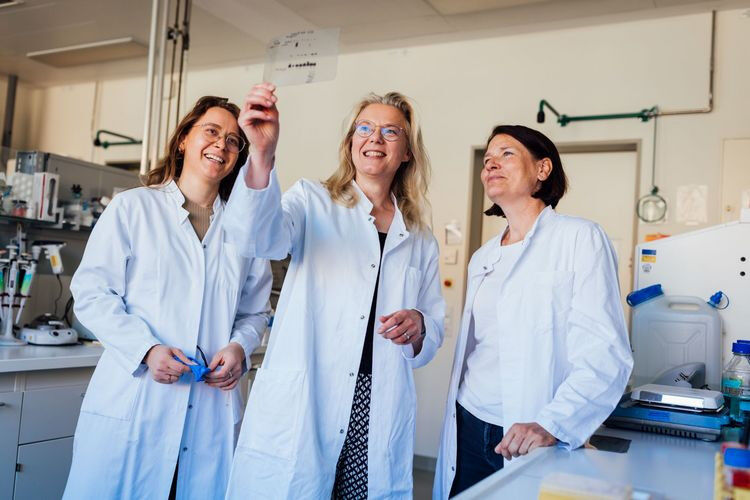
Antje Körner holds a professorship in metabolism research at Leipzig University’s Faculty of Medicine. She heads the Center for Pediatric Research Leipzig (CPL) at the University of Leipzig Medical Center and leads the Childhood Obesity and Metabolic Research team at the Helmholtz Institute for Metabolism, Obesity and Vascular Research (HI-MAG). As co-spokesperson of the Leipzig Center of Metabolism (LeiCeM) Cluster of Excellence, she now has new opportunities to pursue her overarching goal: unravelling the mechanisms behind obesity and its serious secondary conditions, such as diabetes, and developing more effective treatment approaches.
Antje Körner’s working day usually begins at eight o’clock. Meetings - both online and in person - alternate with laboratory studies, desk work and research. She often finds herself back at her computer in the evening, not infrequently working until 10pm. In between, she has dinner with her family. At weekends, she uses the quiet time to write papers or review grant applications. "That requires several hours at a stretch - time I rarely have in my day-to-day routine," says the mother of 13-year-old twins. Her role also involves extensive travel, including monthly trips to Munich. There, she heads the Metabolism Division at the Helmholtz Institute for Metabolism, Obesity and Vascular Research (HI-MAG).
Leipzig excellence with international impact
Körner is regarded as a leading authority in the field of paediatric obesity research. Her work has earned her numerous awards, including the Obesity Prize for Excellence presented by the European Association for the Study of Obesity (EASO) and the Novo Nordisk Foundation - the most prestigious honour in this research field across Europe. "It shows that we here in Leipzig are right at the forefront and internationally visible," she says with pride.
But Körner wants to go further. "What leads to obesity? And how can we identify children at high risk at an early stage and develop effective therapies?" She is also determined to help overcome the stigma that so often accompanies obesity. "’They just need to exercise more and cut down on the crisps’ - remarks like these are something they hear all the time," she explains. For the researchers at the LeiCeM Cluster of Excellence, this serves as a strong incentive to identify more quickly the factors that cause obesity as early as childhood. The aim is to keep the condition under long-term control through early intervention - and to prevent early disturbances in glucose metabolism. A shift in thinking is also required among doctors. "Obesity needs to be taken seriously at an earlier stage and recognised as a disease."
Obesity is complex - and requires complex answers
Körner repeatedly emphasises her holistic approach: "Obesity is a complex disease - and it has to be addressed in a complex way." This includes clinical studies of adipose tissue, genetic research, and work with patients. "In the end, we bring everything together. That is the path we need to take."
Her team works closely with partners both within and beyond Leipzig University. One key project is the long-term LIFE Child study, which Körner established together with Professor Wieland Kiess. Since its inception, the study has followed more than 6,000 children, from pregnancy through to early adulthood. The aim is to understand healthy child development and to identify factors that protect or disrupt it, including diseases and conditions associated with modern life, such as obesity or allergies. On the strength of this expertise, Körner successfully led the Leipzig-Dresden tandem into funding under the German Center for Child and Adolescent Health (DZKJ).
"We are good. A Cluster of Excellence like this belongs in Leipzig."
Antje Körner
Leptin - a hormone that changes everything
"As a medical student, Antje Körner focused on metabolic diseases, including work at the German Diabetes Research Institute in Düsseldorf. A scientific milestone that left a lasting impression on her was the discovery of the hormone leptin by Jeffrey Friedman in 1994. "In the long term, it completely changed how we view adipose tissue," she explains. The insight was clear: adipose tissue is an active organ.

From the outset, Körner was involved in the first research consortia investigating the mechanisms underlying obesity. Together with her team, she published landmark studies showing that obesity often develops in early childhood and persists into later life in more than 90 per cent of cases. A paper published in the New England Journal of Medicine in 2018 has been cited hundreds of times. Shortly afterwards, she and her colleagues were the first to describe a new, inherited form of obesity. "Scientists rarely have the opportunity to discover something so fundamentally new," she says. Her strength: thinking unconventionally and forging new paths
No sooner is one round over than the next one begins
Funding for the LeiCeM Cluster of Excellence opens up major opportunities to promote a more nuanced understanding of obesity and its associated conditions. "We are good. A Cluster of Excellence like this belongs in Leipzig," Körner says with confidence. Projects with the potential to "genuinely change science" are now being selected.
The goal is to produce high-impact publications, generate new insights, and translate these into improved therapies for patients - while also securing success in the next round of the Excellence Strategy. "No sooner is one round over than the next one begins."