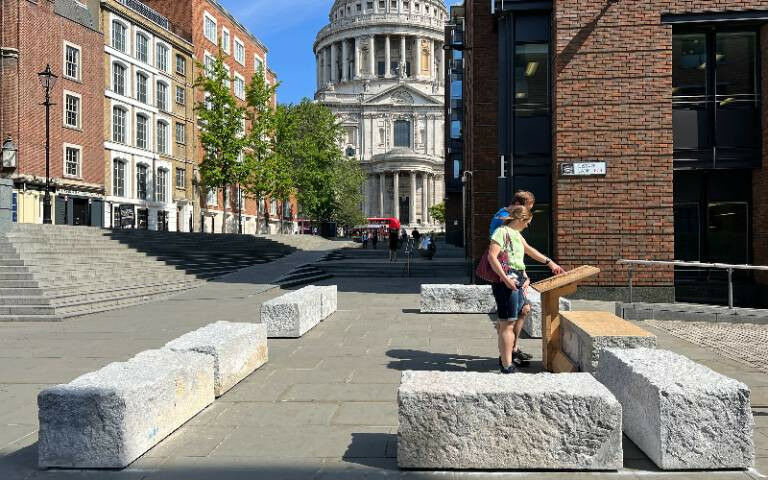
Two pedestrians read the inscription accompanying the stone installation at Peter’s Hill.Two pedestrians read the inscription accompanying the stone installation at Peter’s Hill. Credit: Westminster City Council and Tideway
Two pedestrians read the inscription accompanying the stone installation at Peter's Hill.Two pedestrians read the inscription accompanying the stone installation at Peter's Hill. Credit: Westminster City Council and Tideway To prompt discussion about the circular economy and celebrate the role of stone in the City of London's creation, 58 granite blocks from London's Victoria Embankment on the Thames have been relocated throughout the City, as part of a project designed by UCL architects. Titled 'From the Thames to Eternity,' the stones are placed at seven sites across the City including by St Bartholomew's Hospital, the Millennium Bridge, St Paul's Cathedral and Smithfield Market. They are arranged to provide locations for people to rest and gather, as well as to reflect on the history of the City and the role that material re-use has played throughout. The temporary stone re-use project was designed by Matthew Barnett Howland and Oliver Wilton (both UCL Bartlett School of Architecture and CSK Architects) in conjunction with The City of London Corporation. Matthew Barnett Howland said: "These granite stones from the Thames River wall are remarkable pieces of natural history and cultural heritage, originally quarried in the 19 century, and now available for re-use due to the Thames Tideway Tunnel sewer project." Oliver Wilton said: "By storing and displaying these stones across the City of London, we want to highlight the long tradition of stone re-use in the City and provoke discussion on the need to move to a more circular model in general." London is built on land composed of clay and gravel, with no native stone.
TO READ THIS ARTICLE, CREATE YOUR ACCOUNT
And extend your reading, free of charge and with no commitment.