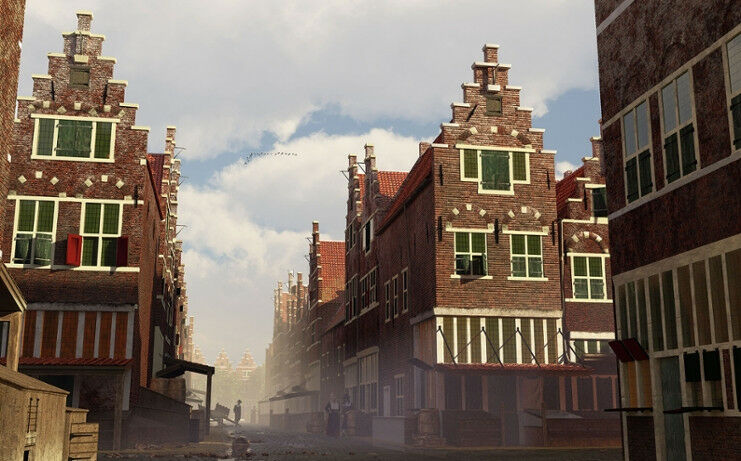
Reconstruction of the junction between the Lange and Korte Houtstraat, looking southeast towards the Leprozengracht.
Reconstruction of the junction between the Lange and Korte Houtstraat, looking southeast towards the Leprozengracht. Exhibition in Jewish Historical Museum What did life use to be like in the Waterlooplein neighbourhood? UvA archaeologists investigated this and created 3D reconstructions of what the neighbourhood must have looked like in the past. The result can be seen in the exhibition 'Waterlooplein: the neighbourhood inside out' at the Jewish Historical Museum from 2 October 2020 through 28 February 2021. The Waterlooplein neighbourhood formed the heart of the former Jewish district in Amsterdam. The exhibition tells stories from four hundred years of this neighbourhood's history by means of photos, film footage, 3D reconstructions and objects. Who lived there? How and why did the residents come to stay in this neighbourhood? And how did they live their lives? Answers to these questions were discovered in the 80s of the previous century, below ground, when the site lay fallow because of the construction of the Stopera. The municipal archaeological service dug up two housing blocks containing 100 cesspits, which contained not only food waste but also all sorts of household effects.
TO READ THIS ARTICLE, CREATE YOUR ACCOUNT
And extend your reading, free of charge and with no commitment.