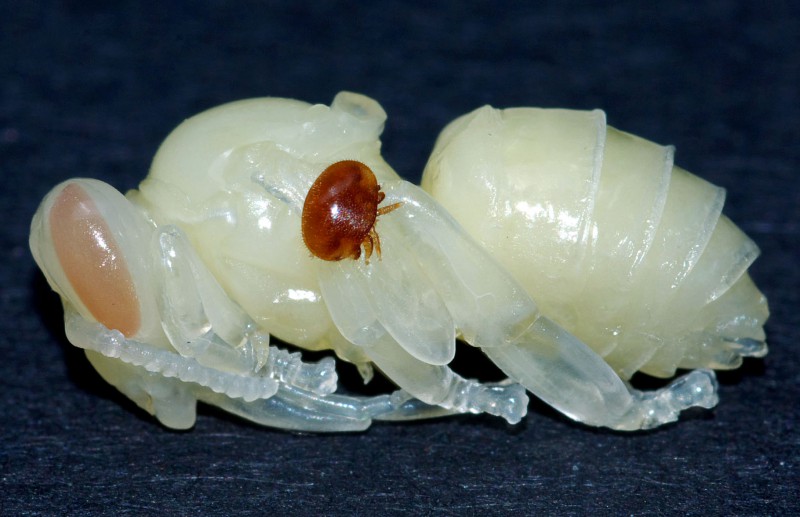
A Varroa mite on a honey bee pupa. Photo: Vincent Dietemann, Agroscope.
Media releases, information for representatives of the media Media Relations (E) Colonies of the Eastern honey bee, the original host of parasitic Varroa destructor mites, survive infestations that are fatal to Western honey bees. A research team from Agroscope and the Institute of Bee Health at the University of Bern (both Switzerland), together with partners from Thailand and China discovered that a large proportion of infested Eastern honey bee larvae die, prompting their elimination from the colony, together with that of their parasites. Counter-intuitively, weak individuals contribute to society survival by preventing the parasite to spread. This is an example of how altruistic suicide can be favoured by nature. There is a general consensus that the parasitic mite Varroa destructor is the greatest biological threat to the health of Western honey bees, globally. This parasite endangers honey bee survival, which may in turn negatively impact pollination services crucial to food security and to the maintenance of biodiversity. 'Sustainable control of this parasite is hampered by our limited understanding of how the original host of this mite, the Eastern honey bee, defends itself', says senior author Vincent Dietemann from Agroscope.
TO READ THIS ARTICLE, CREATE YOUR ACCOUNT
And extend your reading, free of charge and with no commitment.