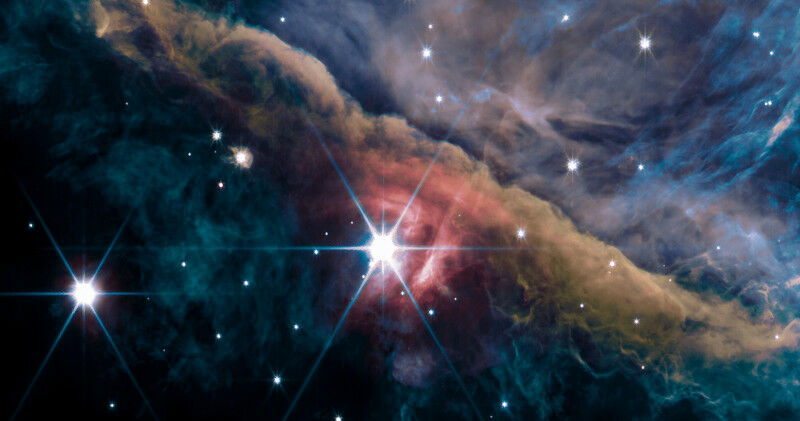
The inner region of the Orion Nebula as seen by the James Webb Space Telescope’s NIRCam instrument. Technical details: The image was obtained with the James Webb Space Telescope NIRCam instrument on September 11, 2022. Several images in different filters were combined to create this composite image: F140M and F210M (blue); F277W, F300M, F323N, F335M, and F332W (green); F405N (orange); and F444W, F480M, and F470N (red). Credit: NASA, ESA, CSA, PDRs4All ERS Team; image processing Salomé Fuenmayor
The inner region of the Orion Nebula as seen by the James Webb Space Telescope's NIRCam instrument. Technical details: The image was obtained with the James Webb Space Telescope NIRCam instrument on September 11, 2022. Several images in different filters were combined to create this composite image: F140M and F210M ( blue ); F277W, F300M, F323N, F335M, and F332W ( green ); F405N ( orange ); and F444W, F480M, and F470N ( red ). Credit: NASA, ESA, CSA, PDRs4All ERS Team; image processing Salomé Fuenmayor - The James Webb Space Telescope (Webb) has captured the most detailed and sharpest images ever taken of the inner region of the Orion Nebula, a stellar nursery situated in the constellation Orion 1,350 light-years away from Earth. The new images released today were targeted by an international collaboration, which includes researchers from Western University. The inner region of the Orion Nebula as seen by the James Webb Space Telescope's NIRCam instrument. This is a composite image from several filters that represents emission from ionized gas, hydrocarbons, molecular gas, dust and scattered starlight.
TO READ THIS ARTICLE, CREATE YOUR ACCOUNT
And extend your reading, free of charge and with no commitment.