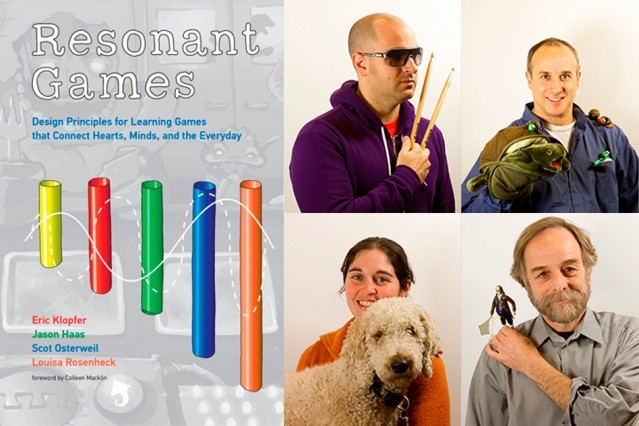
"Resonant Games" is being published by the MIT Press. The authors (top left, clockwise): Jason Haas, Eric Klopfer, Scot Osterweil, and Louisa Rosenbeck Courtesy of the researchers
MIT designers explain their philosophy in a new book, "Resonant Games." To succeed at "Lure of the Labyrinth," a video game created by designers in MIT's Education Arcade, players rescue pets from an underground lair inhabited by monsters. In so doing, they solve mathematical puzzles, decipher maps, wear monster costumes as disguises, and cooperate with Iris, daughter of Hermes from classical mythology. With tenacity, players can foil the monsters' plot and free hundreds of pets. "Labyrinth" is intended for schoolkids. Funded by the U.S. Department of Education's Star Schools program, the game was tested in Baltimore and rural Maryland, used feedback from teachers, and is intended to improve middle-school mathematics and literacy. But it is also meant to be a compelling, competitive challenge in and of itself.
TO READ THIS ARTICLE, CREATE YOUR ACCOUNT
And extend your reading, free of charge and with no commitment.