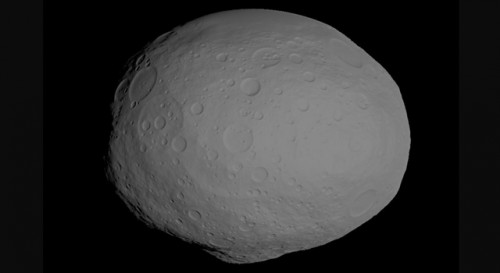
This image shows a model of the protoplanet Vesta, using scientists’ best guess to date of what the surface of the protoplanet might look like. Image credit: NASA/JPL-Caltech/UCLA/PSI <a href=" Full image and caption
On March 29, 1807, German astronomer Heinrich Wilhelm Olbers spotted Vesta as a pinprick of light in the sky. Two hundred and four years later, as NASA's Dawn spacecraft prepares to begin orbiting this intriguing world, scientists now know how special this world is, even if there has been some debate on how to classify it. Vesta is most commonly called an asteroid because it lies in the orbiting rubble patch known as the main asteroid belt between Mars and Jupiter. But the vast majority of objects in the main belt are lightweights, 100-kilometers-wide (about 60-miles wide) or smaller, compared with Vesta, which is about 530 kilometers (330 miles) across on average. In fact, numerous bits of Vesta ejected by collisions with other objects have been identified in the main belt. "I don't think Vesta should be called an asteroid," said Tom McCord, a Dawn co-investigator based at the Bear Fight Institute, Winthrop, Wash. "Not only is Vesta so much larger, but it's an evolved object, unlike most things we call asteroids." The layered structure of Vesta (core, mantle and crust) is the key trait that makes Vesta more like planets such as Earth, Venus and Mars than the other asteroids, McCord said.
TO READ THIS ARTICLE, CREATE YOUR ACCOUNT
And extend your reading, free of charge and with no commitment.