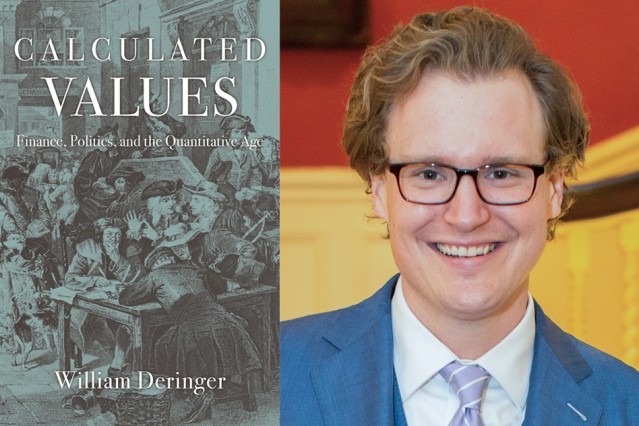
William Deringer of STS has his first book coming out in February about how quantitative economic arguments gained hold in the modern world.
Odds are, you've tried to win arguments by citing statistics. Who has been the greater player, LeBron James or Michael Jordan? Which health care policy is right? Where are the best schools' Which city has the worst morning traffic? If you can find the numbers, then maybe - maybe - you can resolve these matters. But have you ever wondered: When did people start using numbers in politics or other public debates, anyway? Did the Egyptians have quantitative arguments about pyramid policy? Or is it a very recent phenomenon, due to the spread of data and electronic communications? In a new book, William Deringer , an assistant professor at MIT, offers an answer: In the English-speaking world, people started using numbers in political debates in Britain around 1688, and the practice took firm hold over the next few decades. Why then? England had just concluded its "Glorious Revolution," in which William and Mary usurped the throne, deposing James II, while Parliament gained a stronger hold on state affairs. That rise of parliamentary power, along with polarized political parties and the growth of the press, contributed to a public culture of debate and dispute - one in which numbers increasingly became a form of ammunition. "It was part of a larger phenomenon," says Deringer, who is the Leo Marx Career Development Assistant Professor of Science, Technology, and Society. "Issue after issue, you had two sides arguing intensely.
TO READ THIS ARTICLE, CREATE YOUR ACCOUNT
And extend your reading, free of charge and with no commitment.