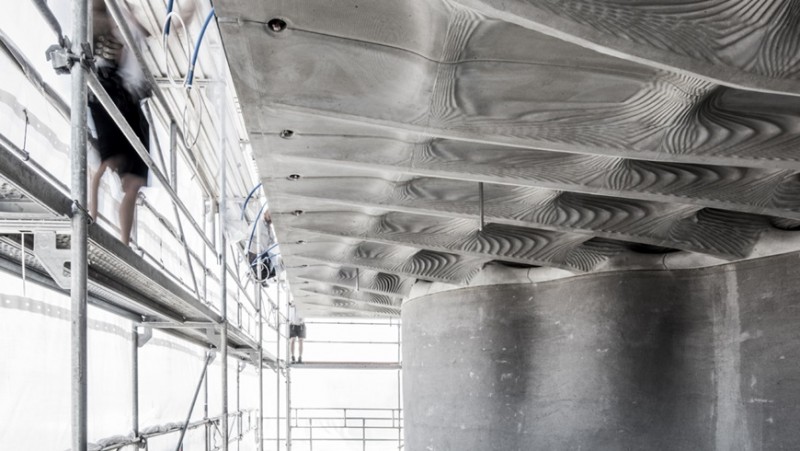
The Smart Slab, resting on the Mesh Mould wall during the installation of the services for the Spatial Timber Assemblies above. Image: NCCR Digital Fabrication / Michael Lyrenmann
Researchers at ETH Zurich have fabricated an 80 m2 lightweight concrete slab at the DFAB House, making it the world's first full-scale architectural project to use 3D sand printing for its formwork. The DFAB House will be built in the NEST building on the Empa and Eawag campus in Dübendorf. Just 20 mm thick at its thinnest point, decoratively ribbed and not even half as heavy as a conventional concrete ceiling: with "Smart Slab", the name says it all. The slab combines the structural strength of concrete with the design freedom of 3D printing. Developed by the research group of Benjamin Dillenburger, Assistant Professor for Digital Building Technologies at ETH Zurich, Smart Slab is one of the core elements of the residential unit DFAB House (see box) at Empa's and Eawag's research and innovation platform NEST in Dübendorf. The 80 m2, 15 tonne ceiling consists of eleven concrete segments and connects the lower floor with the two-storey timber volume above. 3D concrete printing is currently experiencing a boom in architecture, and entire houses have already been printed layer by layer.
TO READ THIS ARTICLE, CREATE YOUR ACCOUNT
And extend your reading, free of charge and with no commitment.