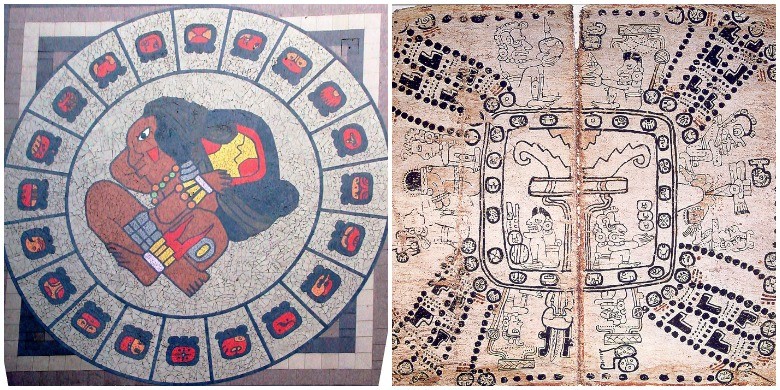
Dates with destiny: The Mayan Tzolkin Calendar (left), from a floor mosaic in Peten, Guatemala, is a copy of an image from an ancient artifact (image courtesy Edgar Del Campo). At right is a representation of the Mayan calendar found in the Codex Madrid, one of four surviving codices before the Spanish conquest.
The idea that the Mayan calendar predicts the end of the world on Dec. 21, which has been jangling nerves worldwide, is being questioned by a University of Alberta researcher. Ann De León , a professor of modern languages and cultural studies at the U of A, says a change will come on that day. But is it an end to everything, or a start to something—a reset of sorts, akin to the one that was supposed to happen in 2000 with the "millennium bug"' Or would it only affect the Maya—a group of tribes indigenous to Central America and the southern parts of Mexico—whose calendar is being touted as the harbinger of a late-December apocalypse? "The Maya did not believe in the end of the world, or their world. They believed in the end of an era and the beginning of a new and improved era," she says. "They believed time went in cycles, or b'ak'tun, which is approximately every 395 years, but each is different and better." De León says the Mayans have different calendars and that not all Mayan communities believe in end of cycles. For example, the Palenque organized time around the life and death of their leaders.
TO READ THIS ARTICLE, CREATE YOUR ACCOUNT
And extend your reading, free of charge and with no commitment.