The Cluster of Excellence "Cross-Cultural Philology" at LMU Munich, which was launched at the beginning of 2026, takes a global look at 5,000 years of written culture. Among them is Würzburg-based Egyptologist Martin A. Stadler.
How have texts evolved over thousands of years, how have they changed and how have they shaped understanding between different cultures? The new Cluster of Excellence "Cross-Cultural Philology", which began its work at Ludwig-Maximilians-Universität München (LMU) at the start of 2026, is dedicated to answering these questions.
Professor Martin A. Stadler from the Chair of Egyptology at Julius-Maximilians-Universität Würzburg (JMU) is part of the cluster. Over the next seven years, he will represent his discipline as one of the leading academics in this international research network. Dr Carolina Teotino-Tattko is working with him on the project.
The art historian and Egyptologist Teotino-Tattko has moved from the University of Tübingen to Würzburg for the project. However, she is no stranger here: Four years ago, she was a research assistant at the Würzburg Egyptology Chair; even then, the Horus Temple at Edfu was at the centre of her work. In the "House of Min", a chapel inside the temple, she has since been researching its significance, ritual function and textual history in close collaboration with the Würzburg team.
25 disciplines work together
The Cluster of Excellence "Cross-Cultural Philology" is one of the largest humanities initiatives funded by the German Research Foundation (DFG). More than 25 disciplines - from musicology to legal history - from 27 international research institutions are working together here to research the diversity of written traditions worldwide.
The aim is to develop a deeper understanding of how people have dealt with texts over the last 5,000 years in order to improve communication between cultures today. The research focuses range from the inscriptions of the kings of Assyria to epigraphic practices in Tibetan cultural areas and Jewish-Arabic texts to lead amulets in pre-modern Scandinavia and the reception of William Shakespeare’s works in Germany.
Egypt’s heritage: more than just rigid hieroglyphs
The University of Würzburg plays a key role within the cluster, as Egyptology investigates one of the oldest and longest-lived written cultures of mankind. Of the total of 5,000 years that the cluster looks at, the Egyptian tradition alone covers around 4,000 years - from the first half of the 4th millennium BC to late antiquity in the middle of the 5th century AD.
"Ancient Egypt produced an incredibly extensive corpus of written sources," explains Martin Stadler. Contrary to the cliché of rigid, unchanging texts, research shows that the ancient Egyptians were very creative with their traditions. Even religious texts were often provided with new variants by the scribes of the time in order to demonstrate their own erudition or even to establish new myths.
Texts in the temple: the Edfu project
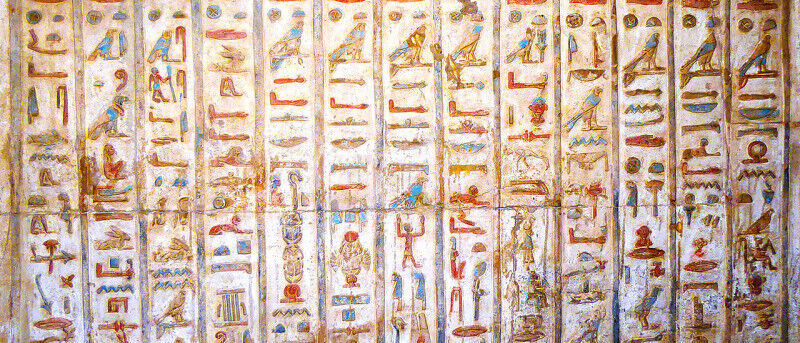
Stadler’s article focuses on The Temple of Horus at Edfu is the best-preserved temple in Egypt; it is located in Upper Egypt, about 100 kilometres south of Luxor, on the western bank of the Nile. Built between 237 and 57 BC, the temple is decorated with a complex system of inscriptions and images. Images and hieroglyphic designs intertwine and make the temple what it is: an image of the cosmos according to Egyptian imagination.
In Edfu, Stadler and his team want to investigate how inscriptions and images interact in the Horus Temple and what significance their special place within the building has. The texts will not be viewed in isolation, but analysed in their relationship to the cardinal points and the architectural structure of the entire temple.
Ancient Egyptian scribes were not mere copyists
Stadler’s earlier research into this temple has shown that the image of ancient Egyptian scribes as mere copyists of rigid "sacred texts" does not apply. Rather, the findings demonstrate a deliberate flexibility. "The scholars demonstrated their own expertise through targeted variants and sometimes founded new myths," says Stadler.
Philology becomes tangible here as a living, individual process in which experts actively played with traditions. These findings show that philological practice was already an expression of independent intellectual achievement thousands of years ago and that texts were always closely related to their spatial environment.
Building bridges between the disciplines
For the University of Würzburg, participation in the Cluster of Excellence offers the opportunity to network Egyptological research closely with other linguistic and cultural studies. "Egyptology can master the balancing act between classical textual work and modern exchange with other disciplines," says Stadler. By comparing Egyptology with other cultures, the researchers hope to gain new insights into how scholars worked in antiquity and how their texts influenced the international exchange of the time.