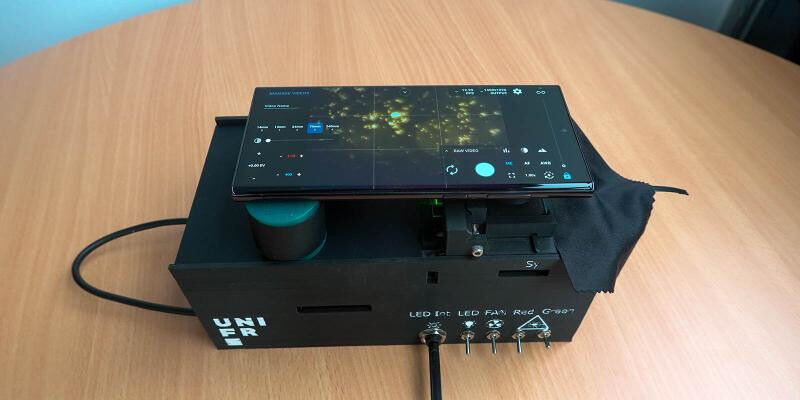
A team of physicists from the University of Fribourg has applied for a patent for a fluorescence microscope that can be operated using a simple smartphone. This very affordable and handy tool enables rapid medical tests, among other things - even outside of hospitals
The fluorescence microscope, invented over a century ago, has established itself as an indispensable tool in biology and medicine. It allows living cells to be visualized in real time, the brain to be mapped and diseases such as cancer and Alzheimer’s to be investigated. However, conventional fluorescence microscopes have several disadvantages: they are heavy and unwieldy, require a reliable power supply and are sensitive to dust and moisture. This makes them difficult to use in the field or by untrained personnel.
The power of smartphones
In order to make fluorescence microscopes accessible to everyone, Guillermo Pedro Acuna, Professor at the Department of Physics at the University of Fribourg, had the idea of using the versatility of smartphones. ’They offer several advantages,’ explains the specialist, ’they are mass-produced and therefore inexpensive, have excellent image sensors and high computing power.’ Thanks to these characteristics, smartphones are increasingly being used in medicine - for example for health monitoring or for quick diagnoses on site without the need to visit a laboratory.
A high-precision pocket microscope
Based on the same principle, fluorescence microscopes that can be coupled with smartphones have been around for around ten years. Although their sensitivity has steadily improved, it has not been possible to detect individual molecules until now. To remedy this ’short-sightedness’, Morgane Loretan, a doctoral student in Acuna’s group, had the idea of using a super-resolution microscopy technique to precisely localize individual molecules
’With this method, we were able to generate images with a localization accuracy of 86 nanometres - i.e. 0.000086 millimetres - which corresponds to an eleven-fold higher resolution,’ says the researcher, who was awarded the Innovation Challenge 2023 prize for this work. The results
Wide range of possible applications
The best thing about it: this ingenious device already exists - and not just on paper. The Freiburg researchers have succeeded in making their fluorescence microscope compact: It weighs just 1.2 kilograms and is barely bigger than a shoe box. The device is easy to use, inexpensive (less than 350 euros) and can be connected to any smartphone with a camera
’To name just one example: With our microscope, a doctor can very quickly determine whether the patient’s symptoms are caused by bacteria or viruses,’ explains Morgane Loretan. ’This would avoid the unnecessary use of antibiotics
But the potential applications go far beyond this: the team assumes that the Freiburg fluorescence microscope can also be used to analyze cancer cells, observe fresh tissue samples or measure hazardous substances in the environment.
Medical diagnostics everywhere
Last but not least, thanks to the use of smartphones, these tests can be carried out anywhere - even without medical infrastructure. The results can then be transmitted to remote servers and analyzed using powerful tools such as artificial intelligence
’This could revolutionize medical diagnostics and prevention - by making it faster, more reliable and accessible to many people at the same time,’ the authors of the study conclude
Loretan, M., Barella, M., Fuchs, N. et al. Direct single-molecule detection and super-resolution imaging with a low-cost portable smartphone-based microscope. Nat Commun 16 , 8937 (2025). https://doi.org/10.1038/s41467-025-63993-z