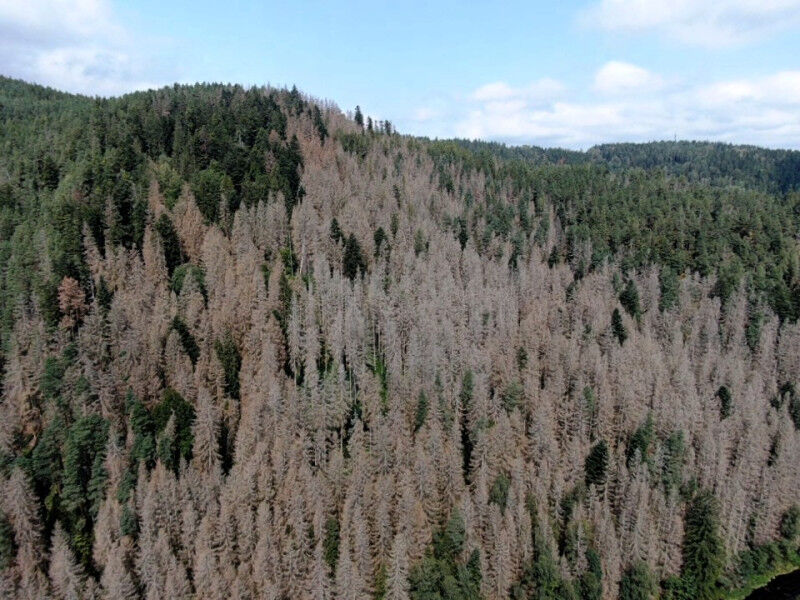
Insect-driven tree mortality is rising across Europe, finds an international study led by the Czech University of Life Sciences with participation of WSL. Conifers are hit harder, broadleaf damage declines. Warm, dry regions are most affected. The results, published in Global Change Biology, can help forest management by informing species choice and climate adaptation.
- Barkand wood-borer impacts on conifers increased substantially in the 21st century, while defoliation by moths decreased across Europe.
- Disturbance of conifers is driven largely by the spruce bark beetle ; in contrast, broadleaved trees are impacted by several species, potentially complicating monitoring and control.
- Species once considered resilient - such as pine and fir - show increasing insect damage, raising concerns about their future suitability.
- Disturbance levels are consistently higher in warmer and drier parts of Europe, signalling elevated future risk under continued warming.
- Populations of insects that share hosts or feeding strategies tend to rise and fall together, increasing the likelihood of continent-scale pulses of tree mortality.
- There is no simple north-south gradient. Regional climate variability and extreme events often outweigh latitudinal effects in insect disturbance patterns.
- Damage from tree pathogens and non-native invasive species was not addressed, but also warrants more attention as seen in the case of ash dieback, for example.
Tree-feeding insects are affecting Europe’s forests increasingly but in uneven ways, according to an international study published in Global Change Biology. The international team from 17 European countries, including WSL for Switzerland, reports that wood-boring insects are causing increasing damage to multiple conifer species, while defoliation caused by caterpillars of different moth species has been declining in recent years. Across temperate and boreal Europe, insect disturbance is consistently higher in warmer and drier regions , indicating the risk of large, sudden impacts as climate extremes intensify.

The findings support policies that shift forest management toward more climate-resilient tree species compositions, with the dominance of broadleaved species, alongside stronger, interoperable monitoring of forest disturbance and data sharing across countries. "We need adaptation strategies that reflect diverging disturbance trends and uneven exposure levels across Europe’s forests," Hlásny said. "This requires effort in coordinated forest risk monitoring, harmonized data collection and sharing, and guidance that can be acted upon by managers and inform markets."
Researchers compiled annual disturbance records from 15 European countries for more than two decades (2000-2022), including data from Swiss Forest Protection and the Swiss National Forest Inventory , which is led by the WSL. The dataset represents 1,361 time series for 50 insect species. The team analysed trends by feeding guild (borers vs. defoliators), host tree species group (conifers vs. broadleaves), and geographic/climatic gradients. The work also introduced a novel harmonized disturbance dataset designed to complement existing monitoring and support future research.
Tomáš Hlásny , Czech University of Life Sciences Prague, Faculty of Forestry and Wood Sciences, Kamýcka 129, 165 00 Prague, Czech Republic, hlasny(at)fld.czu. , +421 905 708 539