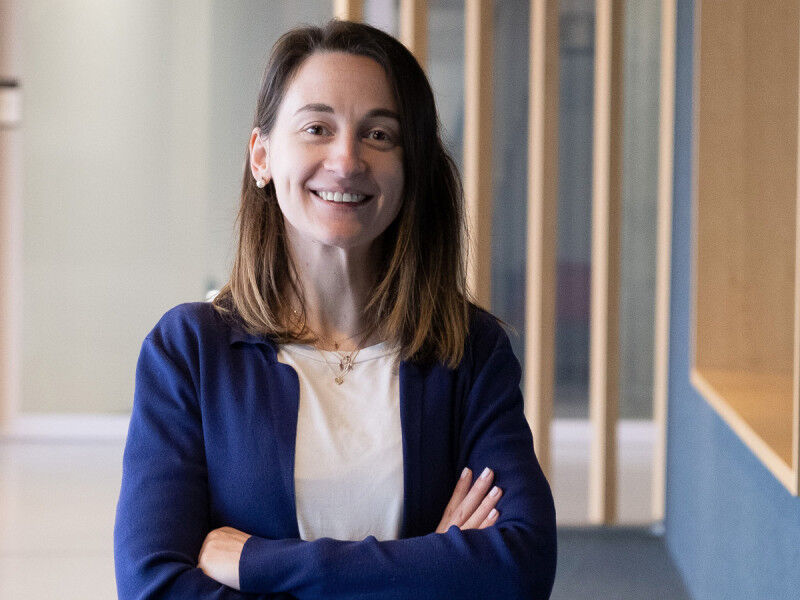
Eleonora Ghisoni, who has won an award from the FBM, has been working for several years as a clinician-researcher in medical oncology. A specialist in ovarian cancer, she is betting on immunotherapy to treat tumors that are often refractory to standard therapies.
In 2025, Eleonora Ghisoni was awarded the "Prix d’excellence de la jeune chercheuse" by the Faculty of Biology and Medicine (FBM). A small crowning achievement for the Italian who, since her arrival in Lausanne in 2019, has led a career divided between her clinical work in the CHUV’s Clinical Oncology Department and her research activity in Dr. Denarda Dangaj Laniti’s laboratory. She has just completed an MD-PhD.
"I studied medicine in Turin, where I began my training in medical oncology. But it was in London, at the Royal Marsden Hospital, that I began to specialize in gynecological tumors and clinical research," explains Eleonora Ghisoni. Thanks to a grant from ESMO, the European Society for Medical Oncology, she was able to develop her translational research project and join the Dangaj Lab in Lausanne, where she found a "very young environment, enthusiastic people with a very high scientific profile". Managing both clinical and research activities at the same time is difficult, admits the doctor, but it’s also a kind of "virtuous circle": "The right questions emerge from the clinic, which we then take back to the lab, to try and find answers and, ideally, come back to patients with new therapeutic strategies. "To carry out this balancing act, she received funding from the ISREC Foundation for protected research time.
The case of ovarian cancer
Her research focuses on ovarian cancer: "These are rare cancers: there are very few cases(editor’s note: around 600 new cases per year in Switzerland, around 3% of all cancers), compared with breast or lung cancers, for example. Nevertheless, they are the5th leading cause of death among all cancers in women. And the leading cause of death if we confine ourselves to gynaecological cancers," points out Eleonora Ghisoni.
What are the reasons for this? "Firstly, there’s the lack of a screening strategy, and the consequences of this: most cancers diagnosed - around 75% - are already at an advanced, metastatic stage. Finally, as far as treatments are concerned, we haven’t seen any real breakthroughs in recent years: admittedly, there are a few new drugs, we’ve improved quality of life and survival somewhat, but these cancers remain highly resistant to all standard therapies. "
For Eleonora Ghisoni, immunotherapy is the way forward. But there’s still a long way to go, and in fact, the road is barely paved: it was only on February 10, 2026 that the first immunotherapy "agent" was approved in the United States, in combination with chemotherapy.
A highly heterogeneous microenvironment
Studies of immunotherapy approaches have so far proved inconclusive. And with good reason, says Eleonora Ghisoni: "In the case of ovarian cancer, we’re dealing with an extremely complex and heterogeneous tumor microenvironment. This is also due to its anatomical location, in the abdomen, in contact with the peritoneum, the membrane that covers all the organs. At the time of diagnosis, we very often find cancer cells already implanted in the peritoneum. "
There is therefore a high degree of intra-tumoral variation, but also inter-organ, between different cancer cell implantation sites, and it goes without saying, inter-patient. All of which makes treatment difficult.
The aim of Denarda Dangaj Laniti’s laboratory is to sift through this tumour ecosystem, studying the main tumour populations and the characteristics of each tumour site. To do this, the team relies on clinical data, but above all on tissue samples or peritoneal fluid - or "ascites", an intra-abdominal fluid effusion frequently occurring in patients with this type of cancer.
Evolution over time
we want to observe the evolution of this ecosystem from diagnosis and during treatment, after exposure to different drugs, after a recurrence," explains Eleonora Ghisoni. And we’re not just interested in cancer cells, but also those of the immune system, such as T cells or macrophages. Which subtype disappears, which subtype proliferates - our aim is to find a "balance" in the ecosystem that makes it more hospitable to immunotherapy, to modulate it for therapeutic purposes. "
Eleonora Ghisoni has thus conducted a vast multicenter study - with 697 samples, the largest ever carried out in this field - published in August 2025 in the journal Cancer Cell. She is also working on the identification of biomarkers that can guide physicians in their therapeutic choices, by combining the advanced technologies of single-cell analysis and spatial transcriptomics.
In immuno-oncology research, the perspective is often vertiginous, with each corner of the veil lifted seeming to reveal a new terra incognita - of the kind indicated with dragons and other sea monsters on medieval maps. Yet Eleonora Ghisoni is not discouraged: "When I started in medicine, immunotherapy was only available for one indication: melanoma. Today, there are over a dozen drugs approved for different indications. So I believe in it, the desire remains, I think we’re heading in the right direction. "