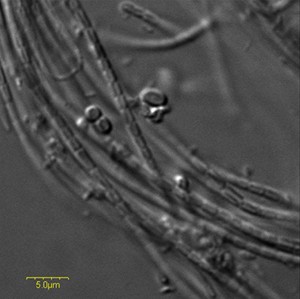
Differential interference contrast image of the cyanobacterial culture from which chlorophyll f was isolated. Image from Science, courtesy of American Association for the Advancement of Science.
University of Sydney scientists have stumbled upon the first new chlorophyll to be discovered in over 60 years and have published their findings in the international journal Science . Found by accident in stromatolites from Western Australia's Shark Bay, the new pigment named chlorophyll f can utilise lower light energy than any other known chlorophyll. The historic study published online in Science , challenges our understanding of the physical limits of photosynthesis - revealing that small-scale molecular changes to the structure of chlorophyll allows photosynthetic organisms to survive in almost any environment on Earth. The new chlorophyll was discovered deep within stromatolites - rock-like structures built by photosynthetic bacteria, called cyanobacteria - by lead author Dr Min Chen from the University of Sydney. A team of interdisciplinary scientists, including Dr Martin Schliep and Dr Zhengli Cai (University of Sydney); Associate Professor Robert Willows (Macquarie University); Professor Brett Neilan (University of New South Wales) and Professor Hugo Scheer (University of Munich), characterised the absorption properties and chemical structure of chlorophyll f , making it the fifth known type of chlorophyll molecule on Earth. Chlorophyll is the essential molecule in oxygenic photosynthesis - the process that enables plants, algae and some bacteria to convert carbon dioxide into sugar and oxygen by using free energy from sunlight. Until recently, oxygenic photosynthesis was thought only to occur in light that is visible to human eyes, between 400nm to 700nm, as chlorophyll was strictly limited to absorbing light in this range.
TO READ THIS ARTICLE, CREATE YOUR ACCOUNT
And extend your reading, free of charge and with no commitment.