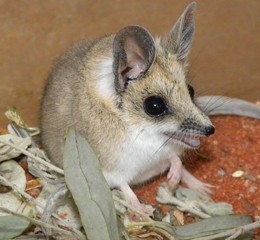
Above: The desert-dwelling dunnart. Photo by Alan Couch / dnatheist, flickr. Below: Dr Wiebke Ebeling with a wallaby. This photo has ben filtered to show the colour scale of 'colour-blind' mammals, such as the wallaby.
Humans are not the only mammal to have good colour vision, according to scientists - in fact, another mammal may be seeing things beyond our own capacity. The research, led by Dr Wiebke Ebeling of the ANU Research School of Biology - now based at the Centre for Marine Science at the University of Tasmania - has revealed that Australian marsupials have more diversity in their colour vision than scientists expected and are far from being 'colour-blind' as expected in other mammals. Based in Dr Jan Hemmi's lab at ANU, Dr Ebeling confirmed that the desert-dwelling dunnart has one more colour dimension than other marsupials but this colour dimension is different from that of humans. 'Unlike previously assumed, humans do not seem to be alone in having good colour vision,' said Dr Ebeling. 'Some Australian marsupials such as the wallaby have colour vision like most mammals and similar to colour-deficient humans. However, others like the small carnivorous shrew-like desert-dwelling dunnart have one more colour dimension at their disposal. Intriguingly, we?re at a loss to explain how this additional dimensionality evolved, from which gene it is expressed, and why it would be beneficial to nocturnal hunters like the dunnart. 'For primates, we always assumed good colour vision would offer an advantage when picking ripe fruit against the background of green foliage. But the ecology of most marsupials doesn't offer a similarly plausible advantage to individuals with colour vision. It would have made perfect sense if all marsupials were 'colour blind' like other mammals, but now we know that there are both colour blind species and those with good colour vision,?
TO READ THIS ARTICLE, CREATE YOUR ACCOUNT
And extend your reading, free of charge and with no commitment.