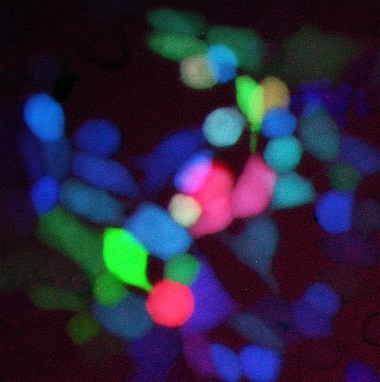
Cells glow brightly 18 hours after being infected with a genetically engineered virus that directs them to produce colorful fluorescent proteins. Princeton researchers hope this virus will have capabilities that exceed those of conventional viral tracers being used today, allowing them not only to map out entire neural circuits, but to distinguish among different sections within a given circuit. (Image: Oren Kobiler)
Imagine an exceedingly complex circuit board. Wires often split - seemingly at random - and connect in strange and unexpected ways. This is how Princeton University researchers developing a new method for studying brain connectivity see the brain. Because of its intricate organization, figuring out the wiring diagram that explains how the billions of neurons in the brain are connected, and determining how they work together, remains a formidable task. But success in this endeavor could transform the field of neuroscience, offering a map toward increased knowledge of how the brain works, with implications for learning more about conditions ranging from depression and schizophrenia to Alzheimer's and Parkinson's disease. Funded by a $993,000 National Institutes of Health Challenge Grant through the American Recovery and Reinvestment Act , Lynn Enquist , a professor in Princeton's Department of Molecular Biology and in the Princeton Neuroscience Institute , is leading an effort to use genetically engineered viruses as explorers that travel throughout the nervous system, tracing the connections between neurons and reporting on their activity along the way. "Over the years, the understanding of how cells in the brain are connected has been a major problem," said Enquist, Princeton's Henry L. Hillman Professor in Molecular Biology.
TO READ THIS ARTICLE, CREATE YOUR ACCOUNT
And extend your reading, free of charge and with no commitment.