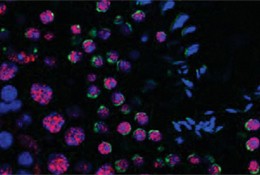
The various stages of sperm cell development.
Male infertility could soon have a boost through new treatments at a sub-DNA 'epigenetic' level, according to researchers from The Australian National University. The research team, led by Professor David Tremethick of The John Curtin School of Medical Research at ANU, have uncovered a new mechanism of gene activation which will have important implications in understanding how cellular differentiation is achieved. In the future, it may also allow the development of new approaches to treat male infertility. Their research is published in the latest . The team which included post-doctoral researchers Tanya Soboleva and Maxim Nekrasov made the breakthrough by looking at what's happening in our bodies at the epigenetic level, which controls how our DNA is expressed. "Epigenetic information goes beyond DNA-stored information essential for interpreting our genome," said Professor Tremethick. "There are over 250 different cell types in the human body, and while the DNA sequence of these is essentially the same, their epigenetic information or profiles are very different.
TO READ THIS ARTICLE, CREATE YOUR ACCOUNT
And extend your reading, free of charge and with no commitment.