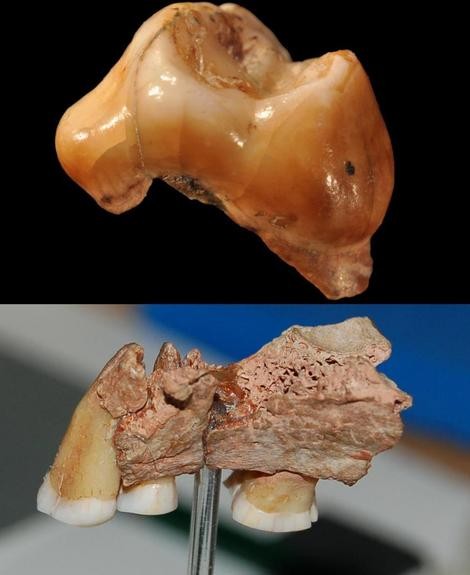
Credits: Dr Stefano Benazzi (infant teeth); Chris Collins (NHM) and Torquay Museum (piece of jawbone with teeth)
Oxford University researchers have provided important new radiocarbon dates for two milk teeth and a jawbone, which shed new light on when the first modern humans arrived in Europe. In the first of the two separate research projects Katerina Douka was part of an international research team re-examining two infant teeth excavated from a prehistoric cave in Italy. The team showed that the teeth are not Neanderthal as previously thought, but belong instead to anatomically modern people. In addition, using the latest dating techniques, she discovered that the teeth are 43,000-45,000 years old - making them the earliest remains of modern humans in the whole of Europe. In a separate study also in Nature , a team of scientists led by Oxford Professor Thomas Higham and Professor Chris Stringer from the Natural History Museum, London, obtained new dating evidence for a tiny piece of jawbone unearthed from Kent's Cavern in Devon, England. The jawbone, which was also found to belong to modern people and not Neanderthals, is significantly older than previously thought - at between 41,000 and 44,000 years old. The new dates, established using the Oxford Radiocarbon Accelerator Unit, are hugely significant as they suggest that modern humans arrived in Europe much earlier than previously believed.
TO READ THIS ARTICLE, CREATE YOUR ACCOUNT
And extend your reading, free of charge and with no commitment.