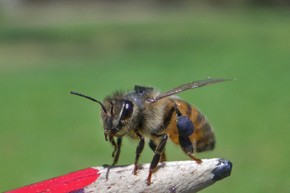
Photo by Mario Pahl.
New research published today online journal suggests that monogamy and close genetic relationships work together to enhance the cooperative social structure of insects such as bees, wasps and ants. Known as haplodiploid animals because males develop from unfertilised eggs and have half the number of chromosomes that females have, the insect colonies are characterised as having a single queen and multiple drones. Co-author of the paper Monogamy and haplodiploidy act in synergy to promote the evolution of eusociality Professor Hanna Kokko from the Research School of Biology at The Australian National University said the theoretical study looked at the logic of interacting genes in haplodiploids. 'It is well known that ants, bees and wasps all form colonies where individuals help each other and form a collective,' she said. 'This paper is about a really old social evolution idea that has experienced a bit of a rollercoaster ride in popularity. 'In the 1970s, Bill Hamilton suggested that the weird genetics of haplodiploid insects could favour cooperation in such systems because sisters are much more closely related to each other than they are in other organisms. 'But this also means that they are less related to brothers so that would potentially make them less cooperative, and therefore people recently started to believe more in monogamy, where the queen mates only once, as a reason behind their social behaviour.
TO READ THIS ARTICLE, CREATE YOUR ACCOUNT
And extend your reading, free of charge and with no commitment.