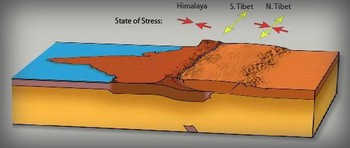
Earthquake mechanisms and the style of faulting in the Himalaya-Tibet region show that the Himalayan range is under north-south compression, southern Tibet is in east-west extension, and northern Tibet is in both east-west extension and north-south compression. The study shows that this pattern can be explained if the strong Indian crust thrust under southern Tibet is transmitting the north-south push of India to northern Tibet.
PASADENA, Calif.—For many years, most scientists studying Tibet have thought that a very hot and very weak lower and middle crust underlies its plateau, flowing like a fluid. Now, a team of researchers at the California Institute of Technology (Caltech) is questioning this long-held belief and proposing that an entirely different mechanism is at play. "The idea that Tibet is more or less floating on a layer of partially molten crust is accepted in the research community. Our research proposes the opposite view: that there is actually a really strong lower crust that originates in India," says Jean-Philippe Avouac, professor of geology and director of Caltech's Tectonics Observatory. These insights lead to a better understanding of the processes that have shaped the Himalaya Mountains and Tibet—the most tectonically active continental area in the world. Alex Copley, a former postdoctoral scholar with Caltech's Tectonics Observatory, along with Avouac and Brian Wernicke, the Chandler Family Professor of Geology, describe Tibet and the surrounding Himalaya Mountains are among the most dynamic regions on the planet. Avouac points out that underground plate collisions, which cause earthquakes and drive up the Himalaya and Tibet, are common geological processes that have happened repeatedly over the course of Earth's history, but are presently happening with a vigor and energy only found in that area.
TO READ THIS ARTICLE, CREATE YOUR ACCOUNT
And extend your reading, free of charge and with no commitment.