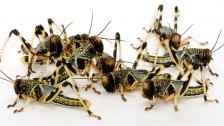
A group of gregarious-phase desert locusts in their final larval stage. Image credit: Tom Fayle, Stephen M. Rogers and Swidbert R. Ott, University of Cambridge
Learning is when you change your behaviour in the light of new experience, and this is what a locust needs to do when it gets caught up in the crowd." - —Dr Swidbert Ott from the University of Cambridge Department of Zoology - New research has found that a protein associated with learning and memory plays an integral role in changing the behaviour of locusts from that of harmless grasshoppers into swarming pests. Desert Locusts are a species of grasshopper that have evolved a Jekyll-and-Hyde disposition to survive in their harsh environment. In their solitary phase, they avoid other locusts and occur in very low density. When the sporadic rains arrive and food is more plentiful, their numbers increase. However, as the rains cease the locusts are driven onto dwindling patches of vegetation. This forced proximity to other locusts causes a little-understood transformation into their 'gregarious phase': they rapidly become very mobile, actively seek the company of other locusts, and thus form huge swarms that sweep the landscape in their search for food.
TO READ THIS ARTICLE, CREATE YOUR ACCOUNT
And extend your reading, free of charge and with no commitment.