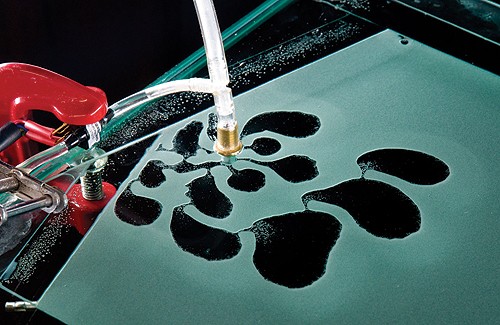
Sand-like particles sandwiched between two plates were injected with air, forcing movement and producing previously unseen patterns.
University of Sydney researchers have discovered new patterns in the movement of granular mixtures with findings that could assist the study of oil and gas recovery and CO2 geo-sequestratrion. Results obtained by lead researcher Dr Bjornar Sandnes, published today, show the answer to the question 'What happens when you inject air into a mixture of sand and water' yields surprising and often beautiful imagery. Dr Sandnes performed numerous experiments whereby tiny sand-like particles sandwiched between two plates were injected with air, forcing movement. He altered rates of air injection, air quantities and density of material in granular mixtures to produce previously unobserved patterns. Mixtures with low granular density and subjected to low to medium rates of air injection - frictional fingering, stick slip bubbles and fluidised front in the above diagram - yielded new patterns. "The interaction of single particles when they get together was pivotal to this research," Dr Sandnes says. "If you push one particle, the impact spreads through networks of particles, or 'force chains', within the material.
TO READ THIS ARTICLE, CREATE YOUR ACCOUNT
And extend your reading, free of charge and with no commitment.