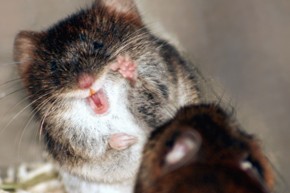
Sexual conflict in bank voles. Photo by M Mökkönen.
New research from The Australian National University has shown how genetic variation persists through generations, rather than being bred out in an evolution towards a 'perfect type'. In an international collaboration, researchers from the Research School of Biology at ANU and colleagues from Finland and France carried out a combined field and theoretical study on the breeding behaviour of European bank voles - a small mouse-sized rodent common in Europe and Great Britain. The research team observed that males which carried the genes for behavioural dominance were more successful at winning mates. However, their gene-sharing female siblings were less successful, having smaller litter sizes. In contrast, females which didn't carry the genes for behavioural dominance had larger litter sizes. This phenomenon is called sexual antagonism - where a particular gene is beneficial for one sex, but decreases success for the opposite sex. Co-author and PhD candidate at the Research School of Biology at ANU Jussi Lehtonen said that the findings show that reproductive success doesn't run in the family.
TO READ THIS ARTICLE, CREATE YOUR ACCOUNT
And extend your reading, free of charge and with no commitment.