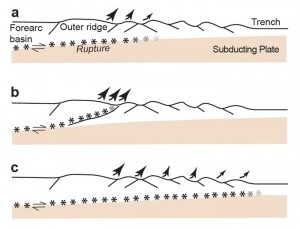
At a typical subduction zone, the fault ruptures primarily along the boundary between the two tectonic plates and dissipates in weak sediments (a), or ruptures along "splay faults" (b); in either case, stopping far short of the trench. In the area of the 2004 Sumatra earthquake, sediments are thicker and stronger, extending the rupture closer to the trench for a larger earthquake and, due to deeper water, a much larger tsunami.
AUSTIN, Texas — An international team of geoscientists has discovered an unusual geological formation that helps explain how an undersea earthquake off the coast of Sumatra in December 2004 spawned the deadliest tsunami in recorded history. Instead of the usual weak, loose sediments typically found above the type of geologic fault that caused the earthquake, the team found a thick plateau of hard, compacted sediments. Once the fault snapped, the rupture was able to spread from tens of kilometers below the seafloor to just a few kilometers below the seafloor, much farther than weak sediments would have permitted. The extra distance allowed it to move a larger column of seawater above it, unleashing much larger tsunami waves. "The results suggest we should be concerned about locations with large thicknesses of sediments in the trench, especially those which have built marginal plateaus," said Sean Gulick , research scientist at The University of Texas at Austin's Institute for Geophysics. "These may promote more seaward rupture during great earthquakes and a more significant tsunami." The team's results appear this week in an article lead-authored by Gulick in an advance online publication of . The team from The University of Texas at Austin, The University of Southampton in the United Kingdom, The Agency for the Assessment and Application of Technology in Indonesia and The Indonesia Institute for Sciences used seismic instruments, which emit sound waves, to visualize subsurface structures.
TO READ THIS ARTICLE, CREATE YOUR ACCOUNT
And extend your reading, free of charge and with no commitment.