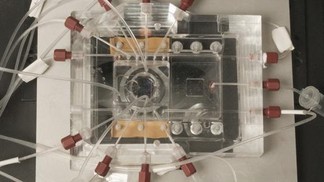
Researchers have developed a miniature on-chip gastrointestinal tract in order to observe the effects of various nutrients on health. The "NutriChip" project's in vitro tests have already begun, on dairy products. What happens in our bodies when we have eaten something? Are "healthy" food products actually good for us, once they have been digested and absorbed? Supported by Nano-Tera and Nestlé, the NutriChip project developed by Martin Gijs's team at the Laboratory of Microsystems at EPFL provides new insights to these questions. The NutriChip is a miniature artificial intestinal wall that can be used to identify foods that cause inflammation in the human body. Preventing chronic inflammatory illness - "Generally, once a given food has been digested and absorbed by the intestine, it carries certain molecules into the body, such as Palmitic acid," says Guy Vergères, a member of the Agroscope Liebefeld-Posieux (ALP) Research Center, which is collaborating on the project. These molecules set off an immune response, in the form of slight, temporary inflammation. Biomarkers for inflammation, notably cytokines, can then be found in the blood.
TO READ THIS ARTICLE, CREATE YOUR ACCOUNT
And extend your reading, free of charge and with no commitment.
Your Benefits
- Access to all content
- Receive newsmails for news and jobs
- Post ads