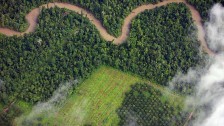
Oil palm plantation Credit: Michael Thirnbeck
New models are being developed to predict how changing land use in the tropics could affect future climate, air quality and crop production. Is this change in land use resulting in unwelcome side-effects on ground-level ozone?" - —Professor John Pyle Ozone has a dual personality best described as "good up high, bad nearby": the atmospheric gas is both vital - and potentially fatal - for our health. High in the stratosphere, the gas filters sunlight and protects us from the damaging effects of ultraviolet light. At ground level, however, it causes respiratory problems and damages crops. 'Bad' ozone is formed by the reaction of sunlight on gases emitted from fossil fuel combustion, and its concentration is predicted to continue to rise unless global emissions can be reduced. But ozone levels are not only affected by emissions from cars, power stations and industrial processes; they are also affected by emissions of volatile organic compounds (VOCs), such as isoprene, by plants. "It's a complicated mechanism," explained Professor John Pyle from Cambridge's Department of Chemistry.
TO READ THIS ARTICLE, CREATE YOUR ACCOUNT
And extend your reading, free of charge and with no commitment.