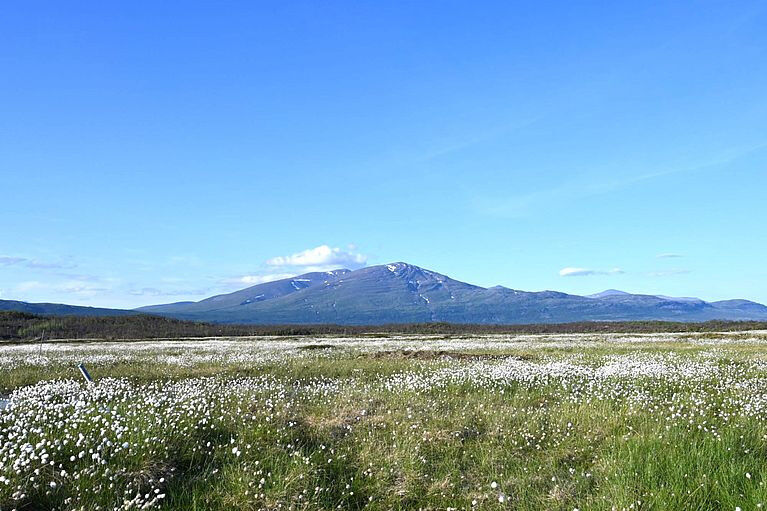
The structure of the plant communities that grow on the thawing permafrost in the Arctic is changing, with grasses displacing slower-growing shrubs. Although these grasses bind more carbon dioxide than previous plant communities, they lead to far more methane emissions over the course of the year. Methane is a greenhouse gas that accelerates the global temperature rise much faster than carbon dioxide. A research team from the University of Tübingen studied this relationship between the plants in the damp to wet soils. Their objective was to quantify the influence of plants on the release of greenhouse gases across the season in the thawing permafrost peatland of Stordalen near Abisko, Sweden. Professor Marie Muehe from the University of Tübingen and the Helmholtz Centre for Environmental Research in Leipzig and Professor Andreas Kappler from the University of Tübingen headed the research. The study has been published in Global Change Biology.
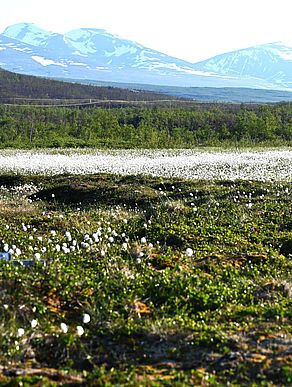
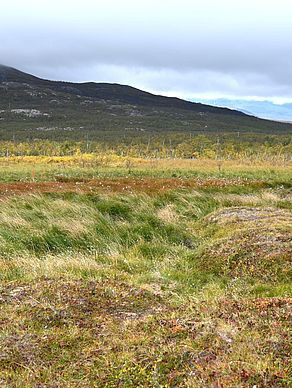
"The typical peat palsas of Stordalen mire are comparatively dry. They lie on top of the permafrost, allowing water to drain off over the underlying ice sheet. As the ice sheet thaws, this flow is disrupted. The peat palsas turn into bogs and eventually fens," says Muehe of the long-term development. As it gets wetter, slow-growing permafrost-adapted shrubs such as bog rosemary or dwarf birch trees are unable to thrive. Sphagnum mosses become established, but they are also eventually replaced by faster and higher growing grasses such as cotton grass and sedge as the ice layer continues to thaw and the ground becomes waterlogged.
Green plants bind the greenhouse gas carbon dioxide as they photosynthesize, and convert it into substances that promote their own growth. "Some of the substances, such as sugars and amino acids, are naturally passed by the plant through their roots into the soil. Microorganisms benefit from these energy sources for their growth," explains Marie Mollenkopf, PhD candidate in Muehe’s and Kappler’s working groups and first author of the study. Which microbes multiply in the root zones of the plants depends on numerous parameters such as the availability of nutrients or the presence of oxygen. "This also gives rise to food chains with one microbe directly using the substances released by the plant, and others making use of the microbe’s secretions. Finally, varying amounts of the green-house gases carbon dioxide and methane are released," says Mollenkopf.
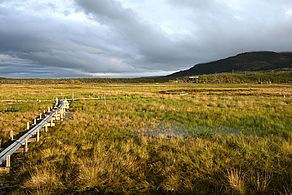
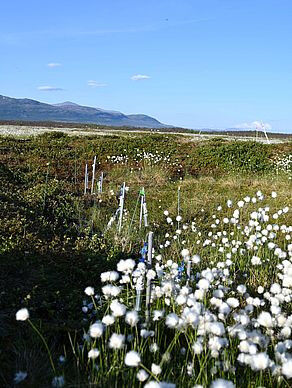
For the study, the research team systematically and quantitatively recorded the carbon fluxes in the root zones of various plant communities on Stordalen mire. Over a growing season, the researchers measured at defined times the plants’ natural root exudates and the greenhouse gases that arose. Numerous environmental conditions relating to soil chemistry were included in the measurements. The whole project involved a comparison of data from the three thaw stages: the original palsas, the bog and the fens.
"Our results show that, above all, the grasses drive the seasonal dynamic of carbon fluxes and green-house gas emissions in the thawed bogs and fens. As the thaw continues, they can release more carbon and in addition actively boost methane emissions," says Mollenkopf. From early to high summer, June to August, the grasses did fix large quantities of carbon dioxide, far more than peat bog or shrubs, through their photosynthesis activity. "But as the growing season progressed, the methane emissions from grasses increased to the highest levels in late summer. As a whole, these methane emissions vastly exceeded the positive effects of carbon dioxide removal from the atmosphere. In addition, more CO2 was released in autumn from reduced photosynthesis activity and dying plant matter. Overall this increased greenhouse gas emissions ninefold," says Muehe. "Permafrost typically becomes a source of carbon as it thaws, with grasses strongly contributing to this carbon release at the end of the growing period."
"Permafrost soils store nearly half of the carbon bound in soils worldwide. By altering soil processes over the course of the year, plants can contribute to thawing permafrost regions, transforming them from a carbon sink to a source faster and more powerfully than previously thought. Global climate models must consider not just the permafrost itself, but the plant activity on it as well," says Marie Mollenkopf.
"The results from Stordalen clearly show that we can only understand climate change and limit it effectively if we know the processes in sensitive ecosystems such as permafrost regions precisely. Researchers from the University of Tübingen are making an important contribution here to a better evaluation of the role of soils in the global carbon cycle. This knowledge is essential to a responsible climate and environmental policy," says Karla Pollman, president of the University of Tübingen.
This research is part of the Cluster of Excellence: EXC 3121: TERRA - Terrestrial Geo-Biosphere Interactions in a Changing World.
Marie Mollenkopf, Katja Lenge, Sören Drabesch, Sylvain Monteux, Sigrid van Grinsven, Prachi Joshi, Ellen Dorrepaal, Birgit Wild, Andreas Kappler, E. Marie Muehe: Graminoids increase greenhouse gas emissions from thawed permafrost at the end of the growing season. Global Change Biology, https://doi.org/10.1111/gcb.70783
University of Tübingen
Official bulletins Disabled access Advice for international students Semester Dates Jobs Organizing Your Studies University Library Programs available Welcome Center for Scholars
System status Corporate Design Conference materials Maps Cafeteria menu Newsletter Uni Tübingen aktuell Studium Generale Uni shop Calendar of events
ALMA Exchange Mail (OWA) Research information system FIT ILIAS, moodle Search for persons at the University (EPV) Praxisportal Timms Video Portal Webmail Uni Tübingen
Geschwister-Scholl-Platz
72074 Tübingen Germany
Contact us