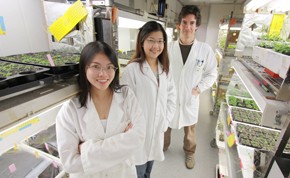
Gonzalo Estavillo (rear) with fellow researchers in the plant growth room. Photo by Tim Wetherell.
Researchers from The Australian National University have discovered a new cellular communication process used by plants to respond to drought. The team, led by Gonzalo Estavillo and Professor Barry Pogson in the ANU Research School of Biology, examined a small, rapid-growing plant called Arabidopsis, a relative of canola. The researchers discovered evidence of a process called retrograde signalling - where chemical signals move between different cellular compartments in the plant. The movement of these signals switches on a defense mechanism which could help plants cope with drought conditions. "The chloroplast is the cellular subunit in a plant that converts light into sugars and is the most expensive cellular compartment to run," said Estavillo. "Thus, the nucleus, or control centre of the cell, needs to ensure efficient assembly and function of the chloroplast and that requires communication between the two compartments. "The chloroplast is also an environmental sensor of stress and this is what initiates the response.
TO READ THIS ARTICLE, CREATE YOUR ACCOUNT
And extend your reading, free of charge and with no commitment.