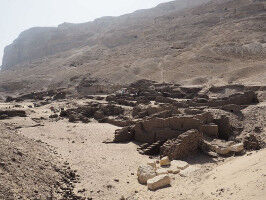
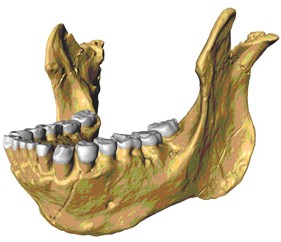
 (Top) Three-dimensional reconstruction of the new lower
jaw KNM-ER 60000, based on a computed tomography scan. © Photo by Fred Spoor (Bottom) Meave Leakey and Fred Spoor collect fossils close
to where the new face KNM-ER 62000 was found.
(Top) Three-dimensional reconstruction of the new lower
jaw KNM-ER 60000, based on a computed tomography scan. © Photo by Fred Spoor (Bottom) Meave Leakey and Fred Spoor collect fossils close
to where the new face KNM-ER 62000 was found.
Exciting new fossils discovered east of Lake Turkana confirm that there were two additional species of our genus - Homo - living alongside our direct human ancestral species, Homo erectus , almost two million years ago. The finds, announced in Nature today, include a face, a remarkably complete lower jaw, and part of a second lower jaw. They were uncovered between 2007 and 2009 by the Koobi Fora Research Project (KFRP), led by Meave and Louise Leakey. Fred Spoor (UCL Department of Cell and Developmental Biology) coordinated the scientific study of the fossils. A critical contribution to the interpretation of the new finds was the preparation of 3D virtual reconstructions using sophisticated computer technology, a task done in close collaboration with his UCL colleague and co-author Christopher Dean. Four decades ago, the KFRP discovered the enigmatic fossil known as KNM-ER 1470 (or "1470" for short). This skull, readily distinguished by its large brain size and long flat face, ignited a longstanding debate about just how many different species of early Homo lived alongside Homo erectus during the Pleistocene epoch.
TO READ THIS ARTICLE, CREATE YOUR ACCOUNT
And extend your reading, free of charge and with no commitment.
Your Benefits
- Access to all content
- Receive newsmails for news and jobs
- Post ads