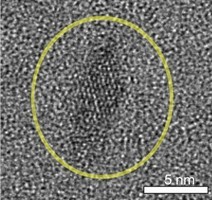
Joel Schrauben/James Mayer/UW This image from an electron microscope shows a coated titanium dioxide nanocrystal.
Chemical reactions on the surface of metal oxides, such as titanium dioxide and zinc oxide, are important for applications such as solar cells that convert the sun's energy to electricity. Now University of Washington scientists have found that a previously unappreciated aspect of those reactions could be key in developing more efficient energy systems. Such systems could include, for example, solar cells that would produce more electricity from the sun's rays, or hydrogen fuel cells efficient enough for use in automobiles, said James Mayer, a UW chemistry professor.
"As we think about building a better energy future, we have to develop more efficient ways to convert chemical energy into electrical energy and vice versa," said Mayer, the corresponding author of a paper about the discovery in the June 8 edition of Science. Chemical reactions that change the oxidation state of molecules on the surface of metal oxides historically have been seen as a transfer solely of electrons. The new research shows that, at least in some reactions, the transfer process includes coupled electrons and protons.
- "Research and manufacturing have grown up around models in which electrons moved but not atoms," Mayer said.
TO READ THIS ARTICLE, CREATE YOUR ACCOUNT
And extend your reading, free of charge and with no commitment.