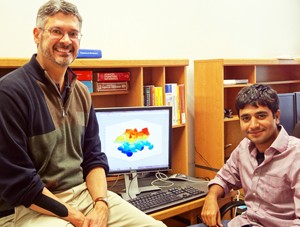
Roger T. Bonnecaze, left, and postdoctoral student Parag Katira.
AUSTIN, TX — Researchers from The University of Texas at Austin's Department of Chemical Engineering are the first to show that mechanical property changes in cells may be responsible for cancer progression - a discovery that could pave the way for new approaches to predict, treat and prevent cancer. Postdoctoral student Parag Katira and his adviser, Roger T. Bonnecaze , department chair in the Cockrell School of Engineering and T. Brockett Hudson Professor, worked with Muhammad Zaman of Boston University to devise a 3-D cancer model that shows the softening of cells and changes in cell binding cause cancerous behavior in cells. These mechanical property changes cause cells to divide uncontrollably - making them less likely to die and resulting in malignant tumor growth. The findings present a unique physics-based perspective on understanding cancer progression and were published recently in the American Physical Society's journal Physical Review Letters. "To date, cancer research has focused on biochemical factors," said Katira. "Instead of looking to solve numerous interdependent biochemical carcinogenic factors, we can now focus on a small number of mechanical factors. It's a new approach." Cancers are caused by various genetic and carcinogenic factors, such as synthetic chemicals, radiation, the environment and physical stress. However, there is an uncanny similarity in mechanical property changes, such as degree of stiffness and ability to bind to other cells, that differentiate healthy and cancerous cells, as previously observed for several types of cancers.
TO READ THIS ARTICLE, CREATE YOUR ACCOUNT
And extend your reading, free of charge and with no commitment.